BALDWIN OF FORDE: BORN 1125
Husband As 12th century Archbishop of Canterbury, Baldwin founded the first major stone church and residence at the site of Lambeth Palace. He needed to stay close to the court and King, and chose a site on the south bank of the Thames, opposite the King’s Palace of Westminster.
BOOKS at amazon

LIFE
Baldwin of Forde or Ford (c. 1125 – 19 November 1190) was Archbishop of Canterbury between 1185 and 1190. The son of a clergyman, he studied canon law and theology at Bologna and was tutor to Pope Eugene III's nephew before returning to England to serve successive bishops of Exeter. After becoming a Cistercian monk, he was named abbot of his monastery at Forde and subsequently elected to the episcopate at Worcester. Before becoming a bishop, he wrote theological works and sermons, some of which have survived.
As a bishop, Baldwin came to the attention of King Henry II of England, who was so impressed that he insisted that Baldwin become archbishop. In that office, Baldwin quarrelled with his cathedral clergy over the founding of a church, which led to the imprisonment of the clergy in their cloister for more than a year. Baldwin spent some time in Wales with Gerald of Wales, preaching and raising money for the Third Crusade. After the coronation of Richard I of England, the new king sent Baldwin ahead to the Holy Land, where he became embroiled in the politics of the Kingdom of Jerusalem. Baldwin died in the Holy Land while participating in the crusade.
Ecclesiastical career
Born in Exeter around 1125, Baldwin was the son of Hugh d'Eu, Archdeacon of Totnes, and a woman of unknown name who later became a nun. Gervase of Canterbury's story that he was from an even humbler background has been shown by modern scholarship to stem from bias on the part of the medieval chronicler.[2] It is possible that he studied at Bologna in the 1150s with the future Pope Urban III. Robert Warelwast, who was Bishop of Exeter from 1138 to 1155, had sent Baldwin to Italy to study law. Baldwin was also said to have taught at Exeter, although this is not substantiated by any contemporary record. In 1150 or 1151 Pope Eugene III appointed him tutor to Eugene's nephew. By 1155, Baldwin seems to have returned to England, where he joined the household of Robert of Chichester, Bishop of Exeter.
Baldwin became a monk in about 1170, and then abbot of the Cistercian monastery of Forde.[12][13] He was well known as a canonist,[14] and often acted as a judge-delegate for the papacy, hearing cases that had reached the Roman Curia and been remanded to local experts for decision.
Baldwin became Bishop of Worcester on 10 August 1180.[18] While at Worcester, he impressed King Henry II by intervening in a secular case to prevent a hanging on a Sunday.
Archbishop of Canterbury
Baldwin was translated from the see of Worcester to the see of Canterbury in December 1184, after Henry II let it be known that he would accept only Baldwin at Canterbury; the previous incumbent, Richard of Dover, had died in April that year. The selection of Baldwin took place only after a dispute between the members of the cathedral chapter of Canterbury and the suffragan bishops of Canterbury, both of whom claimed the right to elect the new archbishop.
Baldwin received his pallium from Pope Lucius III along with Lucius' approval of his translation. Baldwin was named a papal legate in 1185, although his authority was limited to his own archdiocese and did not extend into the Archdiocese of York.
Dispute with Christ Church Priory
During his time as archbishop, there was a dispute with the monks of Christ Church Priory in Canterbury, who resented Baldwin's attempts to impose stricter control over them and disputed the legitimacy of Baldwin's election. For his part, Baldwin did not approve of the luxurious and pampered life the monks of Christ Church lived,[25] and felt that they profited too much from the cult of Thomas Becket.[26]
The dispute escalated when Baldwin deprived the monks of some of the revenues of their monastic estates. After that, Baldwin proposed to establish a church dedicated to Becket in Canterbury itself, staffed by secular rather than monastic clergy. The monks of the cathedral chapter saw this proposed foundation as the first step in an attempt to change the see of Canterbury from a monastic cathedral chapter, a peculiarity of the English Church, to the more normal pattern of secular clergy. It is not clear if Baldwin himself intended such a plan, but the other bishops supported
Service to King Henry II
In 1188, King Henry II of England called for a tax to support the Third Crusade, following the fall of Jerusalem to Saladin in 1187.[29] It was collected at the rate of a tenth of all the property and income of any person not vowing to go on crusade. It was popularly known as the "Saladin tithe" and was the most extensive tax ever collected in England up to that point. Being a tithe and not a secular tax, it was collected by dioceses rather than by shires. Baldwin, especially, was blamed for its harshness, although in February, along with his advisor Peter of Blois, he was in Normandy with the king.
Baldwin took the cross, or vowed to go on crusade, along with King Henry and many others in January 1188, or when he began his preaching campaign on 11 February 1188 to drum up support for the Third Crusade. According to the archbishop's secretary, Peter of Blois, Baldwin was initially opposed to joining the crusade, but was persuaded by Peter to take the cross and to preach the crusade, arguing that it was the archbishop's duty to defend "the vineyard of the Lord of Hosts". Baldwin preached the crusade with Gilbert of Glanville, bishop of Rochester, at Henry's council at Geddington and in April 1188, Baldwin was in Wales on a tour attempting to secure support for the king's crusade, and was forcing his servants and followers to exercise on foot up and down hills in preparation for the journey to the Holy Land. He spent most of the year in Wales, preaching the crusade, accompanied by the chronicler Gerald of Wales. Gerald claimed about 3000 recruits for the crusade from his and Baldwin's efforts in Wales, although he also suggested that Baldwin mainly embarked on the tour to avoid his dispute with the Canterbury monks.
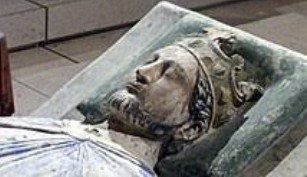
Baldwin was with King Henry shortly before the latter's death, taking part in unsuccessful efforts to negotiate a truce with Henry's heir, Prince Richard, who had rebelled against his father. Baldwin crowned Richard I, shown on his effigy, in 1189.
Under Richard
After the death of Henry II and the accession of Richard as king, the monks of Christ Church Priory petitioned Richard to intercede in the long-running dispute between them and the archbishop. In November 1189, Richard and the whole court, including the Queen Mother Eleanor of Aquitaine, travelled to Canterbury in an attempt to end the controversy before the papacy became involved. Richard finally settled the dispute by persuading Baldwin to abandon his church-building project and to dismiss Norreys. Soon after this, Richard left England, and Baldwin declared that he was going to found the proposed church at Lambeth, and then join Richard on crusade.
Third Crusade
In April 1190, Baldwin left England with Richard on the Third Crusade. Leading the English advance guard, Baldwin left Marseilles ahead of Richard together with Hubert Walter and Ranulf de Glanvill. The group sailed directly to Syria on 5 August 1190.
Baldwin and his group arrived at Tyre on 16 September 1190.[34] Richard did not arrive in Syria until 1191. It is unclear exactly why they were sent ahead of the king; perhaps it was to look out for the king's interests while Richard took a more leisurely route, or perhaps to rid the king's entourage of a family grouping around Glanvill that the king did not trust. Baldwin was not a member or close associate of the Glanvill faction, so most likely he was sent ahead to look after the king's interests, whatever the reasons for the inclusion of his companions. Another concern may have been to get help to the Kingdom of Jerusalem as quickly as possible after the king learned of Frederick Barbarossa's death on the way to the Holy Land.
When Baldwin arrived at Acre on 12 October 1190, the Muslim forces in the city were under siege by the Frankish forces led by King Guy of Lusignan and Queen Sibylla of Jerusalem, who in turn were being besieged by Saladin. As joint commander of the Angevin advance force, Baldwin is described as leading some 200 knights and 300 men-at-arms under the banner of Saint Thomas Becket. Their arrival seemingly revitalised the besiegers' offensive spirit. On 12 November, immediately after the feast of Saint Martin, a significant crusader attack was launched. It is quite possible that the archbishop was already unwell and that participation in the offensive may have contributed to his death a week later.
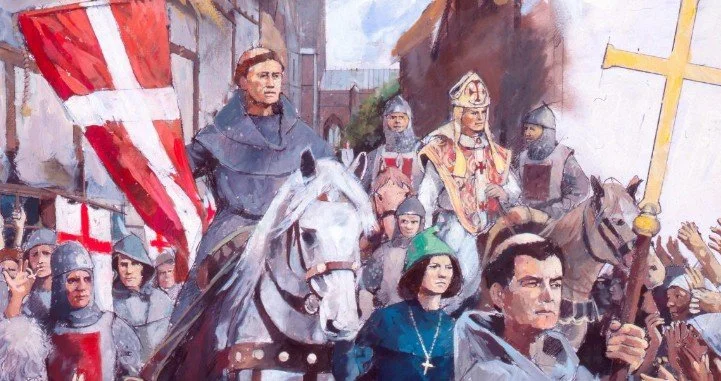
Baldwin of Forde leading his campaign in Wales to recruit for the Third Crusade.
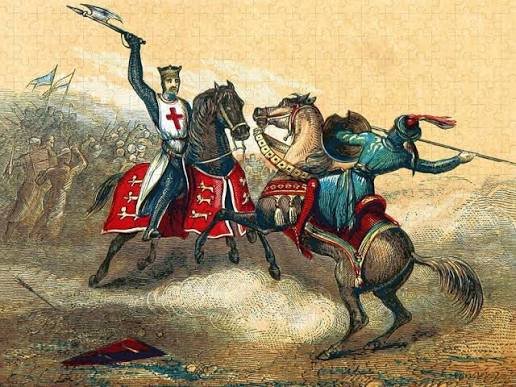
A tricky moment in the Third Crusade.
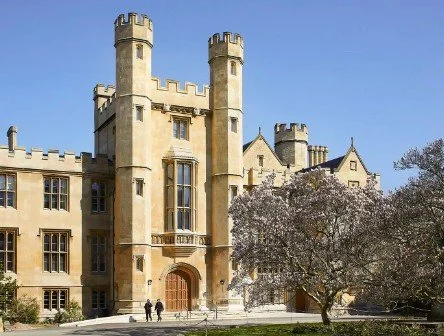
Lambeth Palace today.