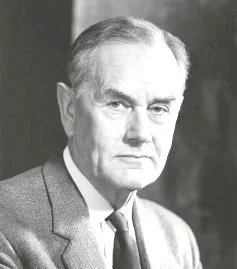
colin buchanan: born 1907
City planner and author of the Traffic in Towns report.
Colin Buchanan became Britain's most famous transport planner in the UK following the 1963 publication of Traffic in Towns. Commisioned by the Government, this presented a comprehensive view of the issues surrounding the growth of personal car ownership and urban traffic in the UK.
Buchanan was born in 1907 in Simla, India, a descendant of a long line of Scottish civil engineers. He was educated at Berkhamsted School in Hertfordshire, before studying engineering at Imperial College, London. His first work was on bridges and roads for the Public Works Department in Sudan. Returning to the UK he then worked on regional planning studies, joined the Town Planning Institute, and in 1935 joined the Ministry of Transport[where he worked on trunk road schemes and road safety.
After serving in the Royal Engineers during World War II and attaining the rank of lieutenant-colonel, he left to join the new Ministry of Town and Country Planning, overseeing planning enquiries into slum clearance and reconciling traffic, planning, and environmental policies.
In 1960 the Minister of Transport, Ernest Marples, appointed Buchanan to head a working group in the Ministry of Transport. In 1963 the group produced the influential Buchanan Report, which proposed how British towns could be redesigned to accommodate growing motor car use, as car numbers in the UK were expected to quadruple over the coming decades.
Buchanan subsequently enjoyed a distinguished career, becoming Professor Transport at Imperial College, obtaining a knighthood, and building a sucessful international consultancy.
In retrospect, his achievements are mixed. He did advocate traffic calming and pedestrianisation in parts of cities. But he promoted the construction of substantial new roads within cities, requiring widespread demolition and the severance of neighbourhoods by major roads. In retrospect what he got most wrong was his advocacy of elevated walkways in cities a few of which, notably at Moorgate in the City of London, were actually built. These proved very unpopular, involving pedestrians in a lot of walking up and down long staircases to get from A to B. They also raised substantial legal, ownership and planning issues where these elevated walkways ran alongside or penetrated buildings. Experience has shown that the best place for pedestrians is on the ground.
PLACES
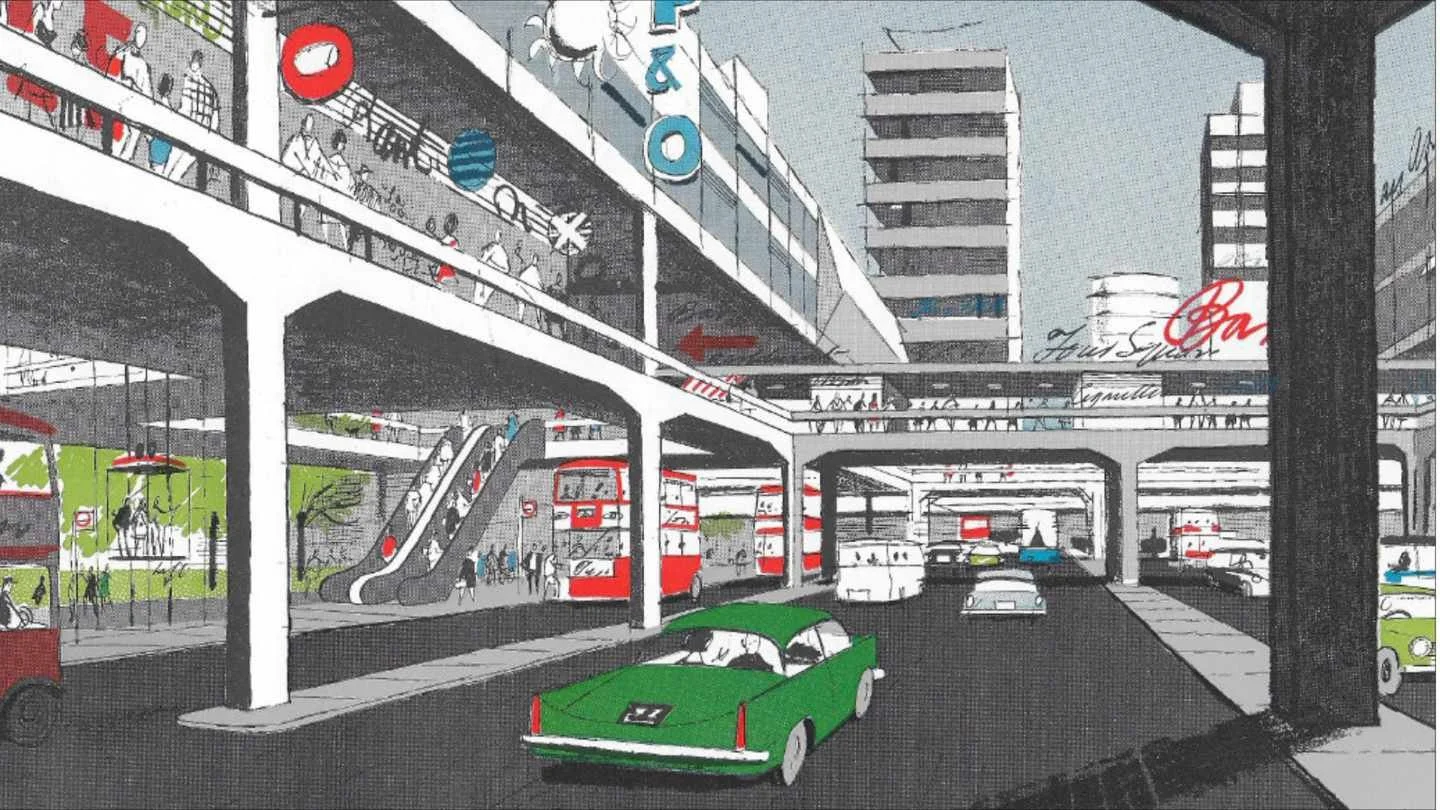
Elevated walkways: the imaginary vision from Buchanan’s Traffic in Towns book.
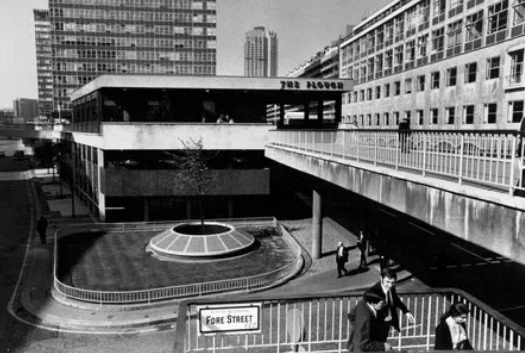
Elevated walkways at London Wall, City of London: the grim reality.
CLICK FOR BOOKS FROM AMAZON