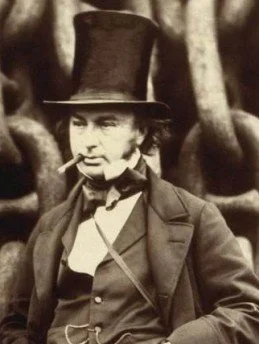
ISAMBARD KINGDOM BRUNEL: BORN 1819
Britain’s greatest 19th century engineer. H was the first to tunnel under the Thames. He built Paddington Station and the Great West Railway. And he turned from land to sea, building the world’s largest ocean liners.
BOOKS at amazon
LIFE
This life of Brunel is reproduced, with acknowledgement and thanks, from the Historic England blog. It was written by Nicky Hughes.
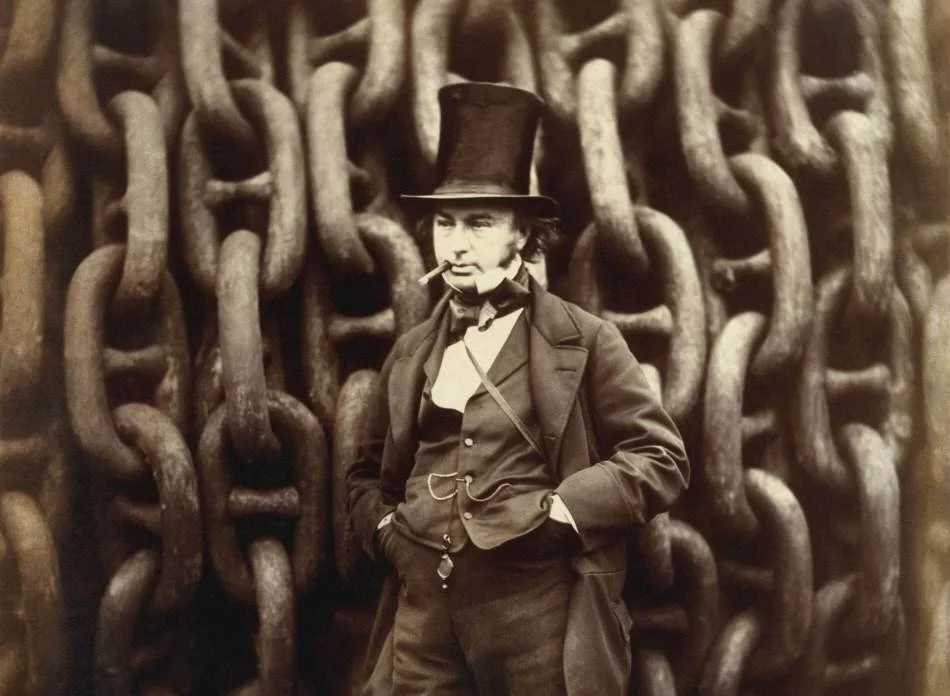
Engineer Isambard Kingdom Brunel stood in front of the enormous launching chains of the SS Great Eastern in 1857. Source: Public Domain.
His originality of thought, extraordinary vision, and risk-taking ushered out the old world of sailing ships and horse-drawn transport. He pioneered a new age, revolutionising engineering and transport with ground-breaking designs for railways, steamships, bridges, tunnels and docks.
EARLY LIFE
Isambard Kingdom Brunel was born on 9 April 1806 in Portsmouth, Hampshire. He was the only son of British-based French-émigré engineer Marc Isambard Brunel (1769 to 1849), a prolific and renowned inventor, and Sophia Kingdom.
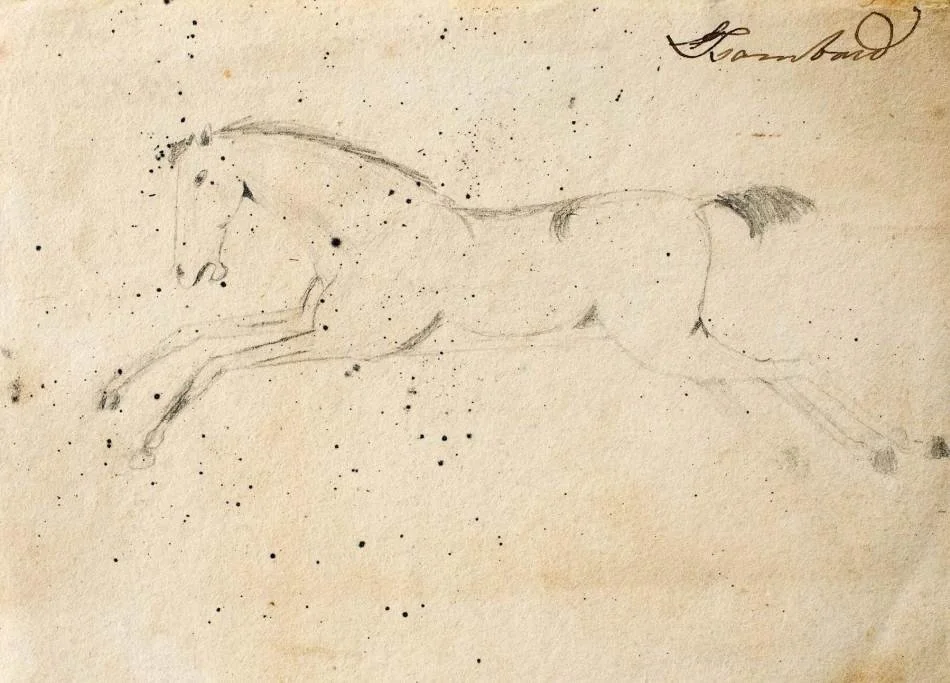
Brunel drew this horse when he was just 6 years old. Source: SS Great Britain Trust.
He taught his son drawing, geometry, and the basic principles of engineering from the age of 4, as well as helping him become fluent in French. Marc wanted his son to be an engineer and sent him to France at 14 for technical schooling, which was unavailable in Britain.Isambard returned to England in 1822 to work in his father’s office. This marked the start of the extraordinary career of this diminutive genius.
THAMES TUNNEL LONDON
During the late 18th and early 19th centuries, two projects were underway to build a tunnel under the River Thames to alleviate the traffic jams on London Bridge, the only downstream bridge in the capital at that time.
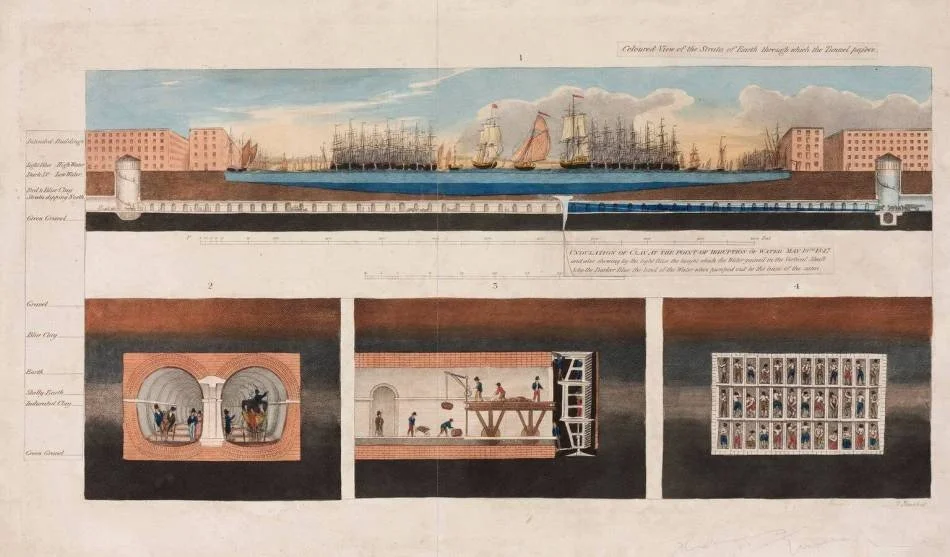
The image below is a cutaway illustration from around 1827 of the Grade II* listed Thames Tunnel showing the rotunda-topped entrance shafts on either side of the river, joined by the 396-metre-long tunnel, 23 metres below the river surface. Source: Creative Commons. View List entry 1242119.
The projects failed due to flooding and the dangerous instability of the area’s clay, mud and quicksand. The concept of the tunnel was deemed impossible. However, Isambard’s father took up the challenge, patenting a tunnelling shield and creating a new tunnel plan in 1823. Private investors funded the project, which began 2 years later, with Isambard joining his father as Resident Engineer in 1827.
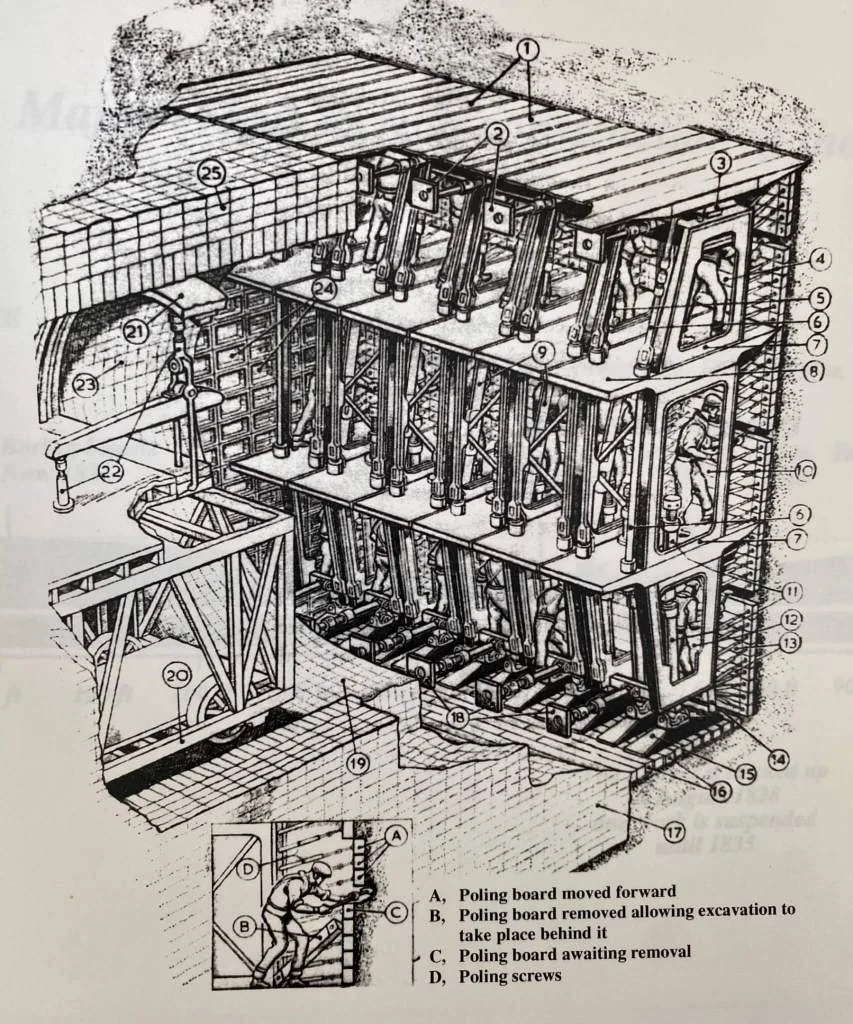
The mammoth 3-storey tunnelling shield is shown below. Each worker is in a separate protective ‘cell’, enabling them to safely dig out sections of soil while the shield kept the rest of the earth in place while constructing the Thames Tunnel. Source: Public Domain.
The excavation was extremely hazardous. There were fires, methane and hydrogen gas leaks, and sudden flooding. Workers drowned, and Isambard himself was revived after being pulled unconscious from a flood. The Thames Tunnel finally opened on 25 March 1843 after 20 years of delays, primarily due to flooding but also due to continuing financial problems.
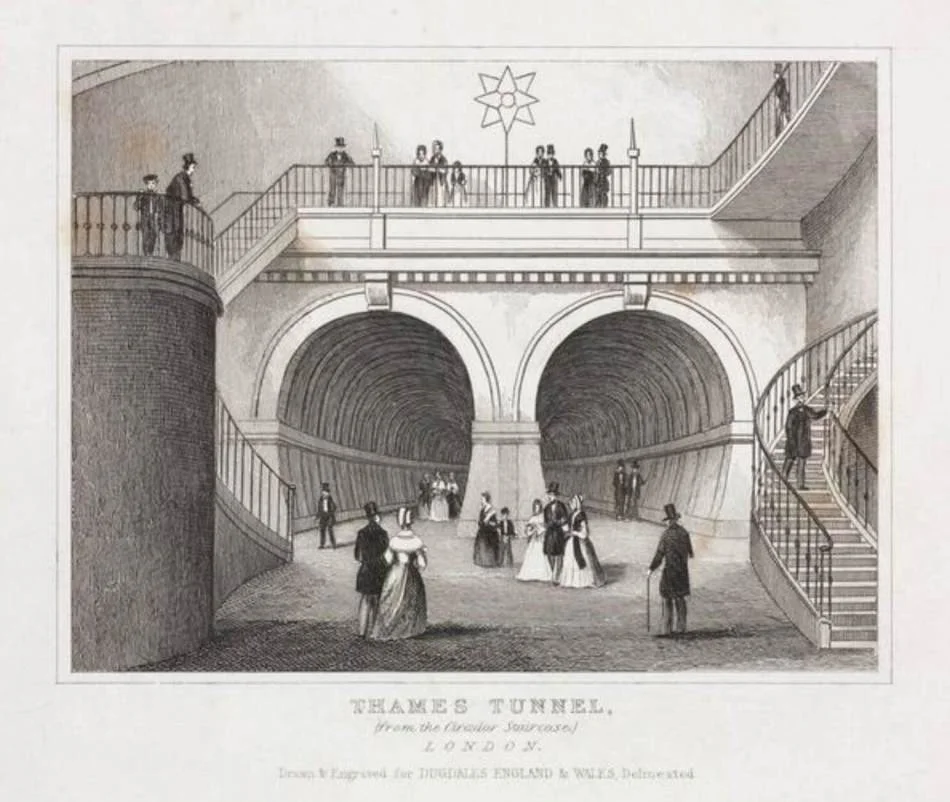
The image above is one of the two circular neo-classical entrance shafts, one onside of the river, leading 25 metres down to the Thames Tunnel. Finely dressed tourists descended the marble spiral staircases that were hung with paintings. Source: Creative Commons. View List entry 1242119.
The Brunels’ structure was the first subaqueous tunnel in the world. This was a spectacular triumph of engineering. But it was a failure financially. Initially intended for horse-drawn vehicles to alleviate traffic across the river, extending the entrance shafts to accommodate them proved too prohibitively expensive. The tunnel instead became a major Victorian tourist attraction.
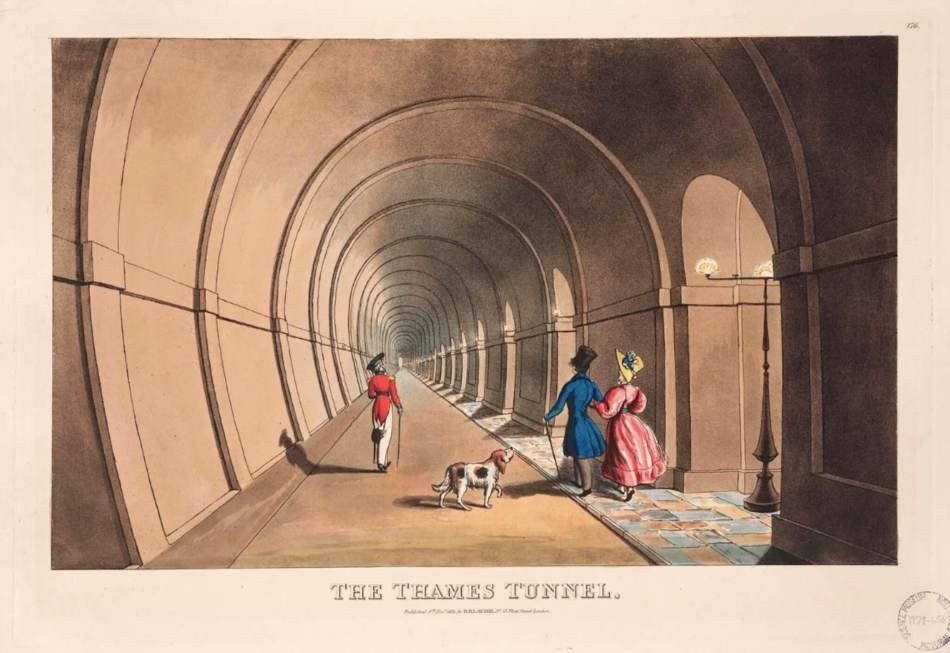
An aquatint print by RH Laurie (1777 to 1858) of the Thames Tunnel. Source: Creative Commons. View List entry 1242119.
An estimated 2 million people a year paid 1 penny to visit. Smart shops selling fancy goods were sited within the arches between the 2 tunnels. They were decorated with marble counters, gilded shelves and mirrors, and brightly lit with gas burners. The tunnel’s popularity as a tourist destination gradually waned, and it became the haunt of sex workers and robbers.
In 1865, the East London Railway Company bought it and converted it into a railway tunnel. The first steam trains ran through it in 1869. Later, it became part of the London Underground’s East London line. In 2010, it was repurposed as part of the new London Overground.
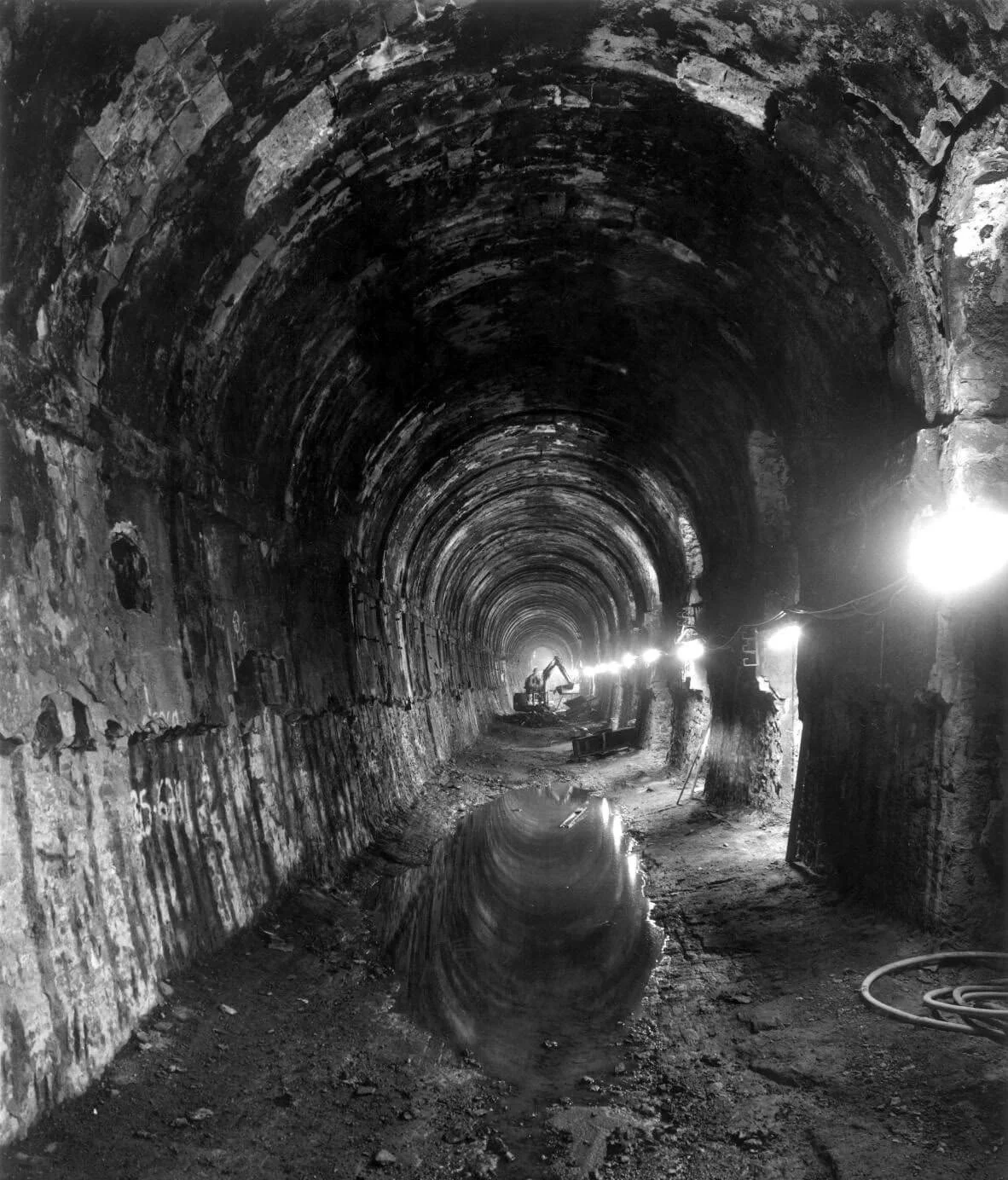
Above: The interior of the East Thames Tunnel, photographed in 1996. © Crown Copyright. Source: Historic England Archive. View image BB96/00714. View List entry 1242119.
GREAT WESTERN RAILWAY
The opening of the Stockton and Darlington Railway in 1825, the world’s first goods and passenger railway, and later the Liverpool and Manchester Railway with George Stephenson’s engine ‘Rocket’, proved the vast potential of railways in the 19th century.
A lithograph from around 1840 showing the interior of the original Bristol Temple Meads train shed, designed by Brunel. Grade I listed. © Historic England Archive. Misc/014. View List entry 1282106.
To compete with the rival port of Liverpool over Atlantic trade, Bristol needed a railway to link it with London. In 1833, Brunel was appointed Chief Engineer of the Great Western Railway (GWR), previously the Bristol Railway Company.
Brunel surveyed each mile of the GWR London to Bristol route himself on horseback, negotiated with landowners, controlled contracts, and designed most of the route’s buildings and bridges. However, the route presented Brunel with enormous technical difficulties.
Bridges had to be constructed, such as Maidenhead Bridge over the River Thames in Buckinghamshire and the Royal Albert Bridge spanning the River Tamar between Plymouth, Devon, and Saltash, Cornwall (both Grade I listed).
Viaducts, such as the Grade II* listed viaduct in Chippenham, needed to be built, and new stations had to be established all along the route, including the termini of Paddington and Bristol Temple Meads.
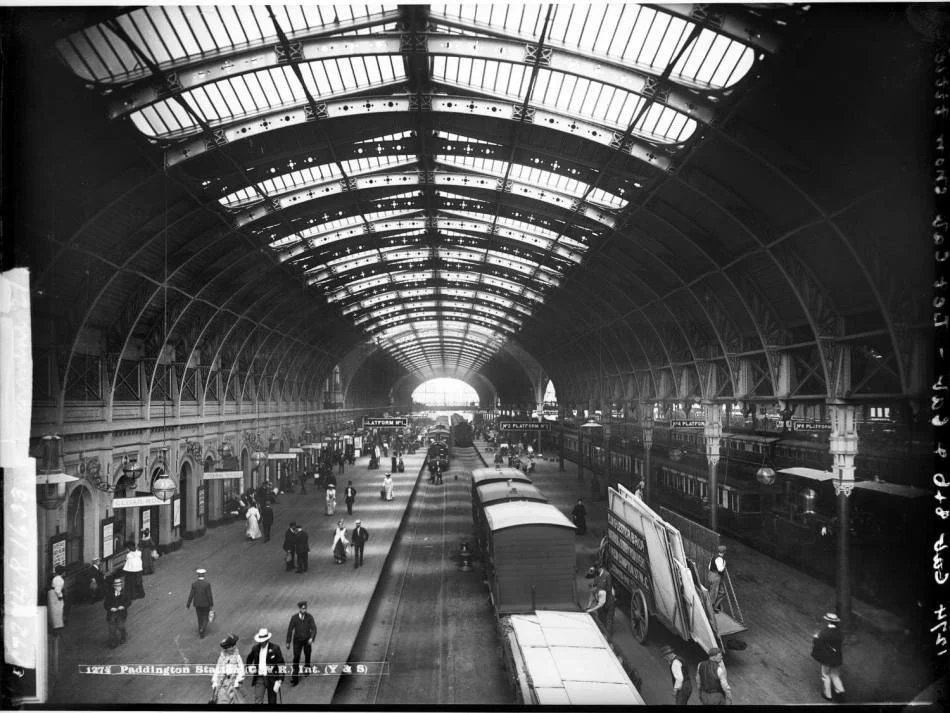
The interior of the Grade I listed Paddington Station, probably in the late 19th century. Designed by Brunel, it opened in 1854. © Historic England Archive. View image CC97/01127. View List entry 1066881.
An immense team of over 1,000 navvies excavated and constructed the route by hand. 3 viaducts, 4 major bridges, and 7 tunnels were built between the Bath and Bristol section alone. The first leg from Paddington to Maidenhead opened in 1838. It reached Reading by early 1840 and Swindon by the end of the year.
However, between Bath and Chippenham, Brunel faced one of his greatest engineering challenges: creating a tunnel nearly 3 kilometres long through solid rock. The Box Tunnel took 3 years to construct. In the final months, around 4,000 workers used 1 tonne of explosives every week to blast through the rock, along with 1 tonne of candles for illumination. 20 million bricks were laid. An estimated 100 workers died during the construction. When completed in 1841, the Box Tunnel was the longest railway tunnel in the world. In June 1841, the Great Western Railway London to Bristol route finally opened. In the following years, the growth of the railways boomed across the country. Brunel was the chief engineer for GWR’s expansion. Over 1,200 miles had been built under his design and supervision by his death.
TAKING TO THE SEA
Some of Brunel’s later and most spectacular projects were the building of enormous trans Atlantic steamships, including the SS Great Western, then the longest ship in the world. As these shipbuilding projects were not in London, we do not cover them here.
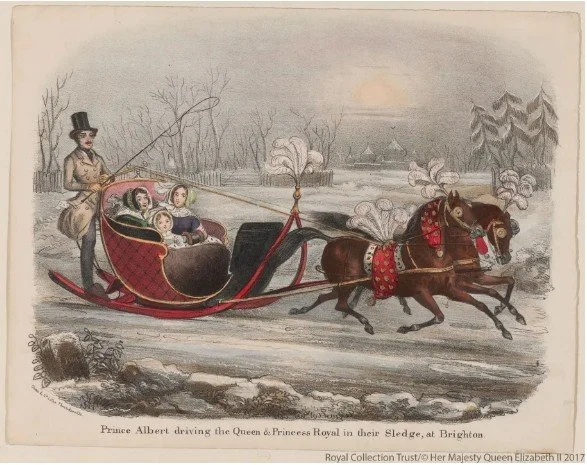
Prince Albert and his young family enjoying a sledge ride at Brighton.
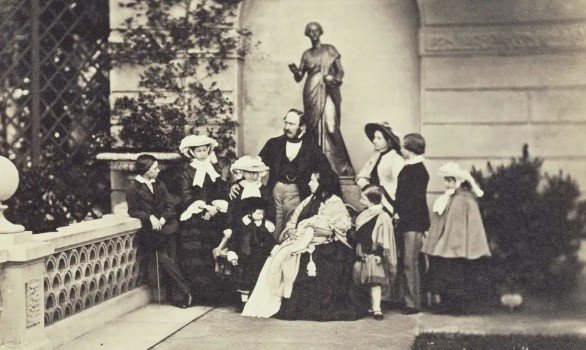
Price Albert and Queen Victoria with all their children on holiday at Osborne House, Isle of Wight.
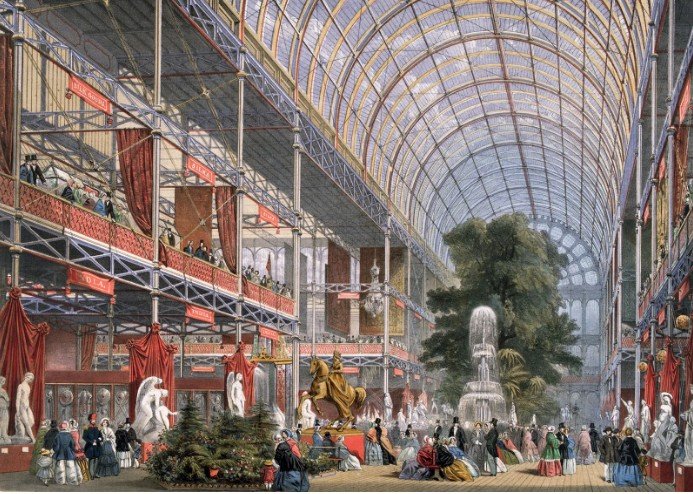
Interior of the 1851 Great Exhibition in the Crystal Palace, inspired by Prince Albert and designed by Joseph Paxton. Appropriately, the building
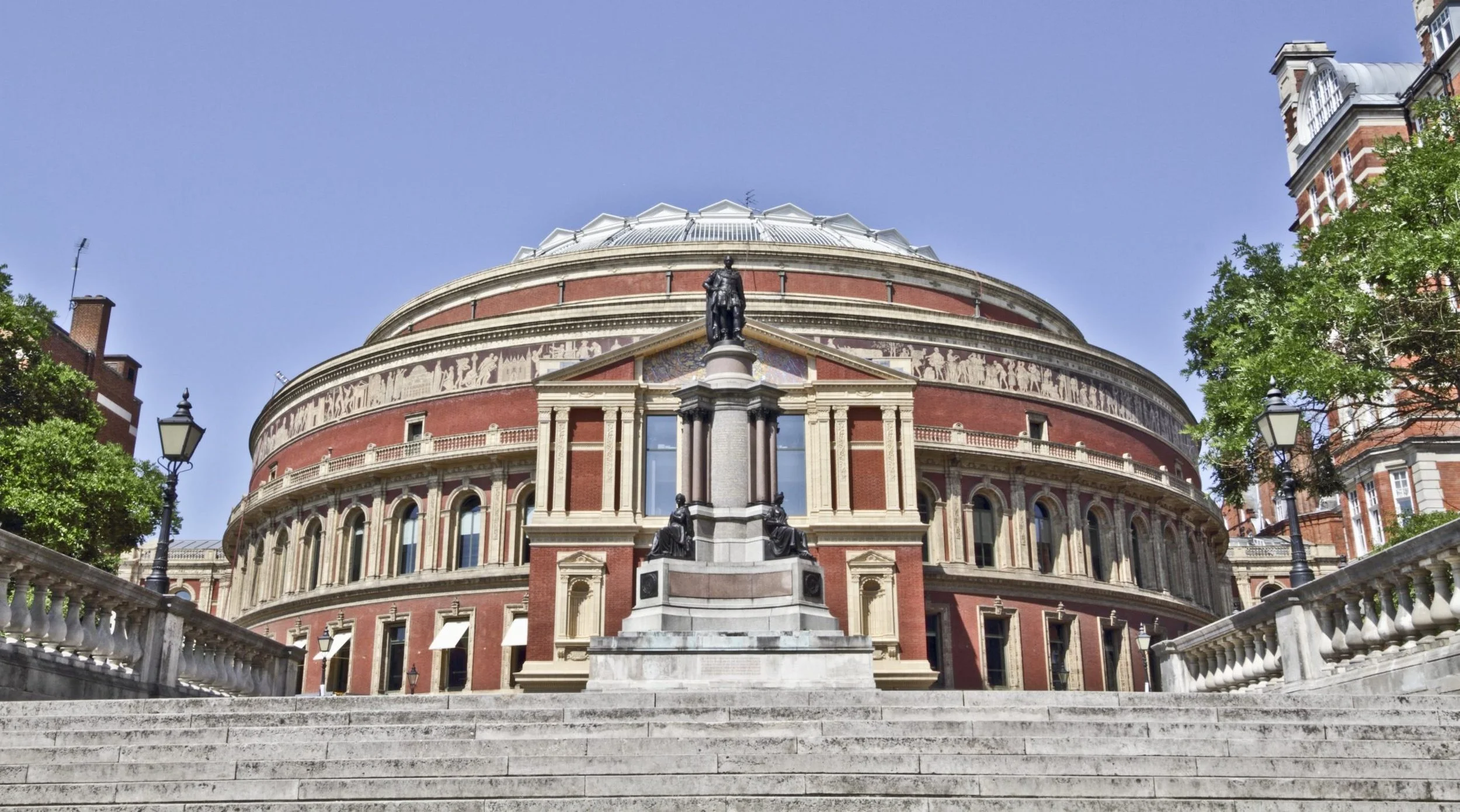
Royal Albert Hall, part of Prince Albert’s grand scheme for a South Kensington cultural quarter, with buildings funded by the profits from the 1851 Great Exhibition.