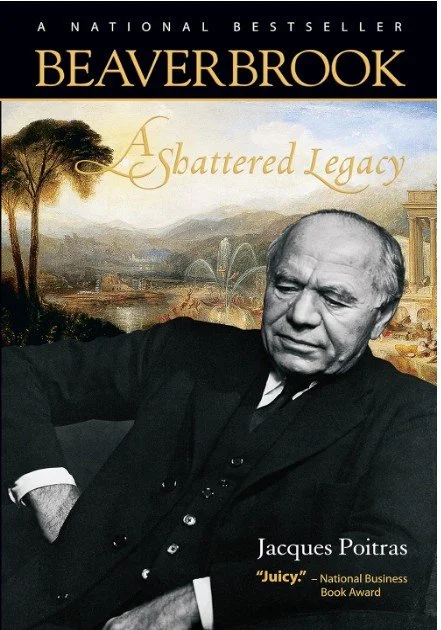
LORD BEAVERBROOK: BORN 1879
Developer of the 1932 Daily Express building in Fleet Street.
William Maxwell Aitken, enobled as Lord Beaverbrook, was a prominent Canadian-born businessman, politician, and newspaper publisher who significantly influenced British political and media landscapes in the 20th century. Born in 1879 in Ontario, Canada, Beaverbrook grew up in a middle-class household and achieved wealth through savvy business ventures, becoming a millionaire by his thirties. His political career began in the UK, where he was elected to the House of Commons and later appointed to the House of Lords during World War I.
Beaverbrook's impact extended beyond politics; he became a leading figure in British journalism by acquiring and transforming major newspapers like the Daily Express into influential platforms. His journalism was characterized by a classless approach, appealing to a broad audience. During World War II, he served as Minister of Aircraft Production, contributing significantly to Britain's wartime efforts and the successful defense during the Battle of Britain.
After the war, Beaverbrook continued his involvement in the media and political discourse, opposing Britain's integration into the Common Market and advocating for Commonwealth partnerships. Despite his outsider status as a Canadian in British elite circles, Beaverbrook left an enduring legacy in both media and political history, demonstrating a unique blend of entrepreneurial spirit and public service until his death in 1964.
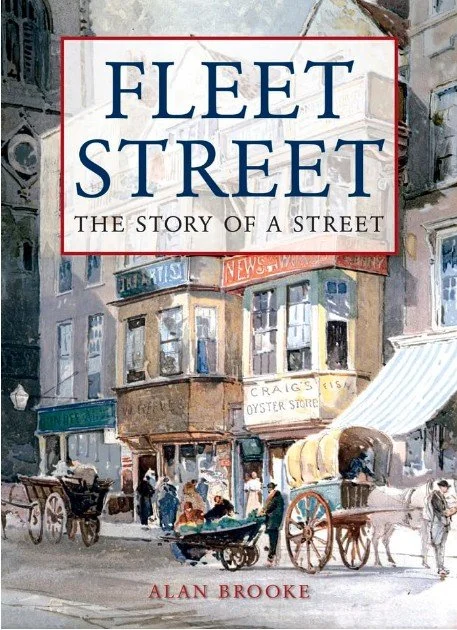
Beaverbrook’s notable contribution to London buildings was the Daily Express building at 120 Fleet street. It was designed in 1932 by Ellis & Clarke to serve as the home of his Daily Express newspaper and is one of the most prominent examples of art-deco / Streamline Moderne architecture in London.
The exterior features a black façade with rounded corners in vitrolite and clear glass, with chromium strips. The flamboyant lobby, designed by Robert Atkinson, includes plaster reliefs by Eric Aumonier, silver and gilt decorations, a magnificent silvered pendant lamp and an oval staircase. The furniture inside the building was, for the most part, designed by Betty Joel.[1]
The Grade II* listing relates not only to the architectural features but also to the massive reinforced concrete stacked portal frame structure designed by Sir Owen Williams.
As part of a redevelopment of the surrounding site the building was entirely refurbished in 2000 by John Robertson Architects. The foyer was recreated largely from photographs and the façade completely upgraded. The concrete portal frame structure was preserved.
PLACES
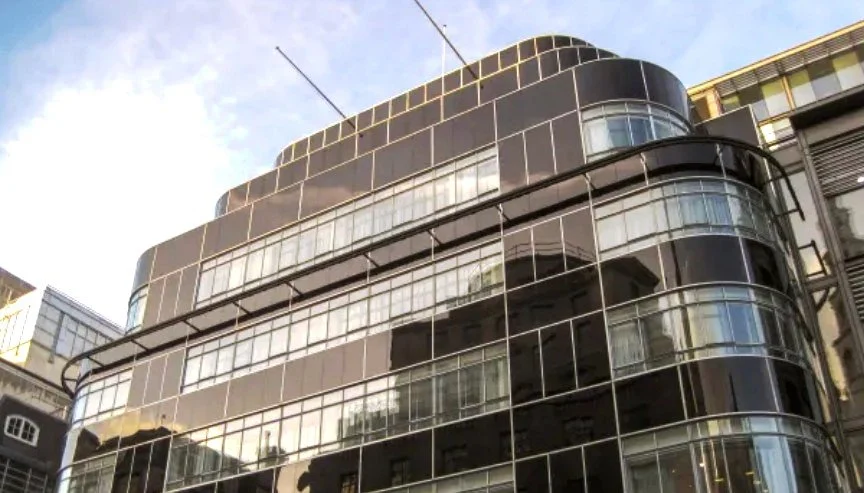
Vitrolite and clear glass facade of Daily Express building, 120 Fleet Street.
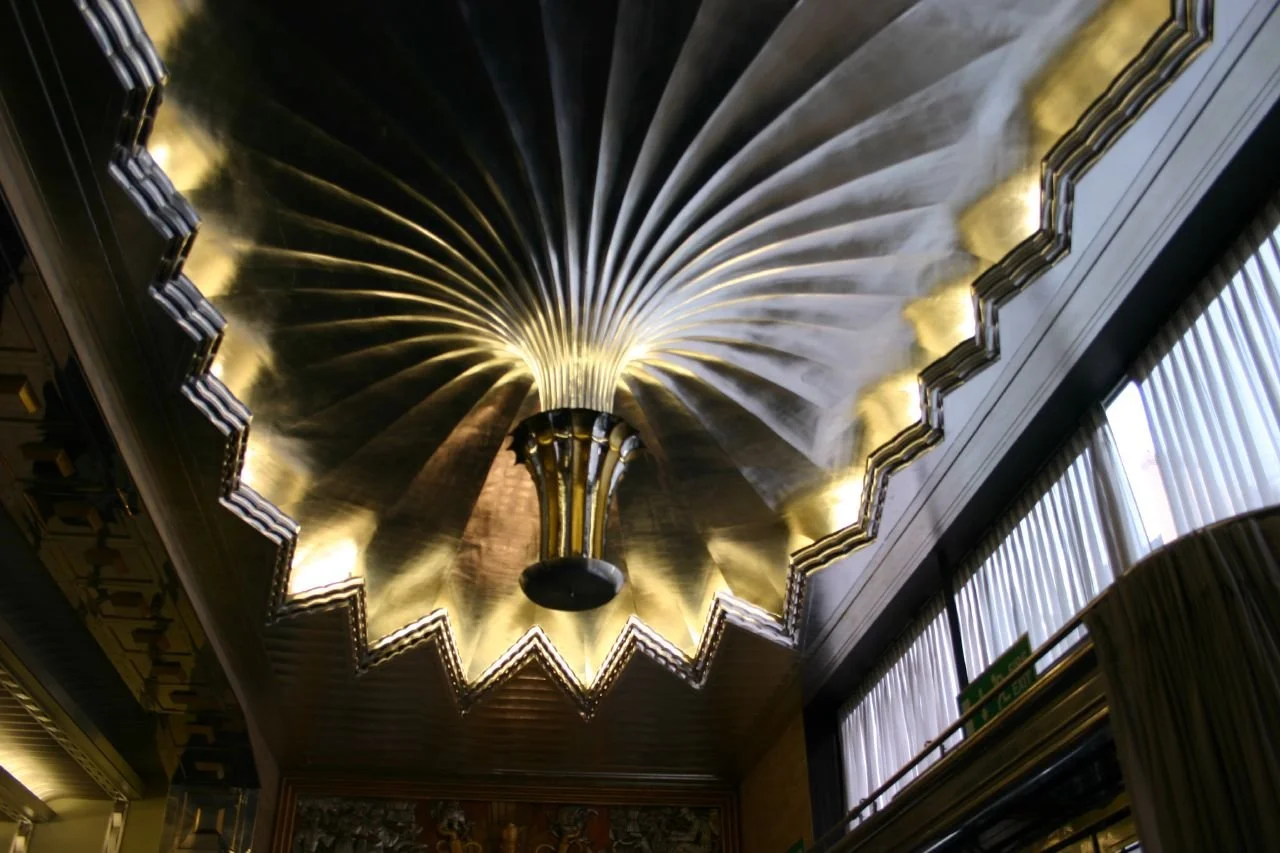
Foyer ceiling of the Art Deco entrance lobby at the Fleet Street Daily Express building after the 2000 refurbishment. The building is now occupied by US bankers Goldman Sachs.
CLICK FOR BOOKS FROM AMAZON