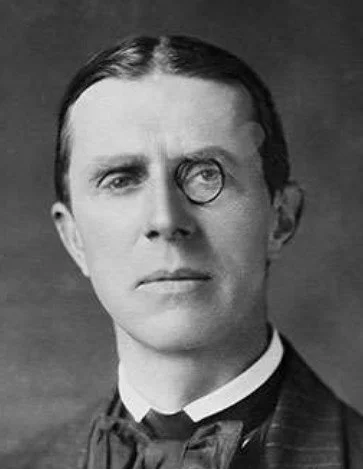
PATRICK ABERCROMBIE: BORN 1879
Planner, during the Second World War, of massively destructive road building in London.
Sir Leslie Patrick Abercrombie FRIBA was an English architect, urban designer and town planner. Abercrombie was an academic during most of his career, and prepared one city plan and several regional studies prior to the Second World War. He came to prominence in the 1940s for his urban plans for the cities of Plymouth, Hull, Bath, Bournemouth, Hong Kong, Addis Ababa, Cyprus, Edinburgh, Clyde Valley and Greater London.
Patrick Abercrombie was born in Ashton-upon-Mersey, the seventh of nine children of Sarah and William Abercrombie, a stockbroker and businessman who had wide artistic interests, particularly of the Arts and Crafts school.
In 1897, he was articled to the architect Charles Henry Heathcote, while studying at the Manchester School of Art. After a year working in Chester with architect Philip Lockwood, son of renowned architect T.M Lockwood, in 1907 he was offered a post as junior lecturer and studio instructor at the University of Liverpool School of Architecture. In 19150 je was appointed as Lever Professor of Civic Design at Liverpool, soon becoming a nationally-known authority on town planning and the garden city movement.
Abercrombie was later appointed as Professor of Town Planning at University College London, and gradually asserted his dominance as an architect of international renown, which came about through the replanning of Plymouth, Hull, Bath, Edinburgh and Bournemouth, among others. Of his post-war replanning of Plymouth, Sir Simon Jenkins has written:
Poor Plymouth. It was badly blitzed in the Second World War and then subjected to slash and burn by its city fathers. The modern visitor will find it a maze of concrete blocks, ill-sited towers and ruthless road schemes. Most of this damage was done by one man, Patrick Abercrombie, in the 1950s. The old Barbican district would, in France or Germany, have had its façades restored or rebuilt. Here new buildings were inserted with no feeling for the texture of the old lanes and alleys.
Abercrombie is best known for the post-Second World War replanning of London. In 1943 he created the County of London Plan, and in 1944 the Greater London Plan, together commonly referred to as the Abercrombie Plan. Abercrombie conceived the Ringways scheme of London in 1944, proposing four ringroads around Greater London.
A positive outcome of the Abercrombie Plan was the creation of several new towns, including Harlow, north of London. These were intended to provide a modern and healthy alternative to the Victorian slums of London.
His plans for new Ringway roads around London were much more problematic. They wuold have involved the demolition of thousands of dwellings to create multi-lane roads carving through historical parts of central London. Mercifully only small parts of this scheme were built, notably the elevated Westway and the West Cross Route in west London. In 1970s opinion thankfully shifted against this kind of destructive inner city road building and the Ringway roads concept was abandoned before more damage could be done.
PLACES
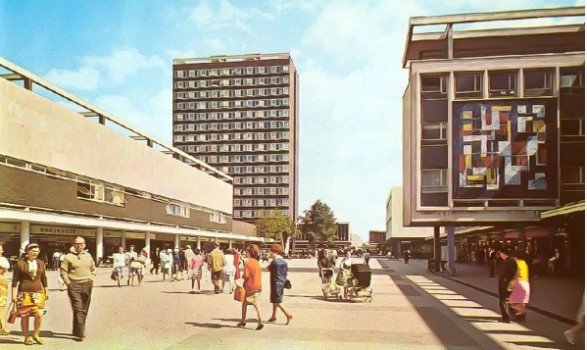
Harlow New Town.
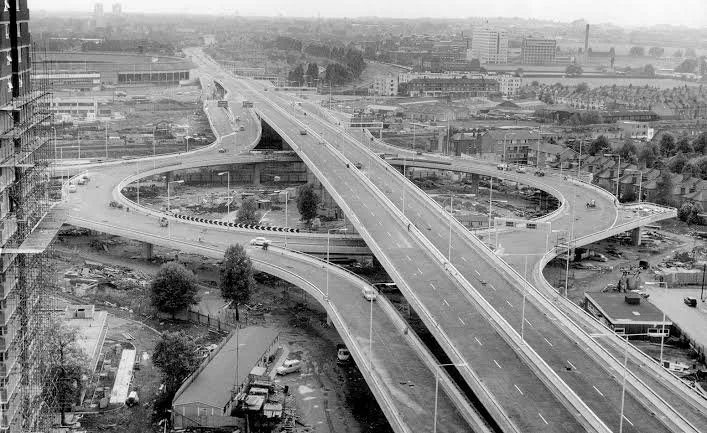
The Westway interchange, at the border of Kensington and Hammersmith, west London.
CLICK FOR BOOKS FROM AMAZON