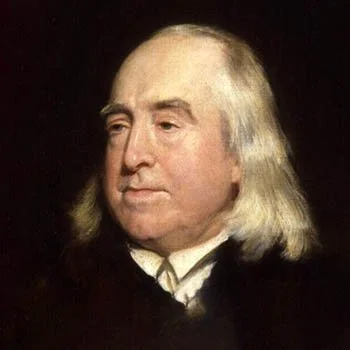
JEREMY BENTHAM: BORN 1748
PHILOSOPHER
The ideas of philosopher Jeremy Bentham inspired the founding of University College London. Unlike its predecessors Oxford and Cambridge, it was open to women and to teachers and students of all faiths or none.
Bentham is famous for his principle that "it is the greatest happiness of the greatest number that is the measure of right and wrong". He was an early promoter of many progressive views, including the separation of church and state, equal rights for men and women, the right to divorce, the abolition of slavery, and the abolition of capital punishment.
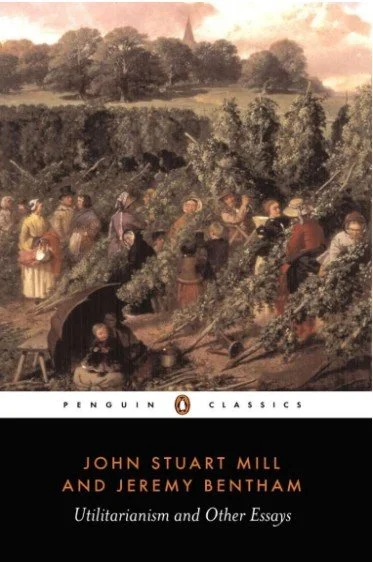
BOOKS FROM AMAZON


LIFE
Jeremy Bentham was born in London in 1748 and died in 1832. He devised the doctrine of utilitarianism, arguing that the ‘greatest happiness of the greatest number is the only right and proper end of government’. He was a major thinker in the fields of legal philosophy and representative democracy, and originated modern ideas of surveillance through his scheme for a Panopticon prison. He supported the idea of equal opportunity in education and his ideas contributed to the foundation of University College London in 1826, the first institution in England to admit students of any race, class or religion and the first to welcome women on equal terms with men. Bentham’s ideas have tremendous relevance to contemporary society; engaging with his thinking helps us to understand better the world we live in today.
Bentham’s Circle
Bentham had many associates and acolytes. He was invited to Bowood, the house of William Petty, 2nd Earl of Shelburne and 1st Marquess of Lansdowne, where he met Samuel Romilly and Étienne Dumont. He was friends with Henry Brougham, George Grote, David Ricardo and the radical artisan Francis Place. Perhaps his most significant relationship was with James Mill and his son John Stuart Mill, both of whom were profoundly influenced by, and helped to edit, Bentham’s works. James Mill met Bentham around 1808 and spent summers with Bentham and his circle at Forde Abbey, Bentham’s country house in Somerset. The Mills lived in a house owned by Bentham on Queen Square (now Queen Anne’s Gate). Bentham’s ideas inspired James Mill’s Essay on Government (1820) and the work of John Stuart Mill including On Liberty (1859) and Utilitarianism (1863).
The Auto-Icon
In his will Bentham left his body to medical science. He also requested that his body be preserved and this ‘Auto-Icon’, as Bentham called it, was gifted to University College London in 1850 by Bentham’s surgeon, Thomas Southwood Smith. Today Bentham sits in UCL’s South Cloisters dressed in his own clothes and sitting in his chair. You can visit the Auto-Icon from 09:00 – 18.00 on Monday to Friday.
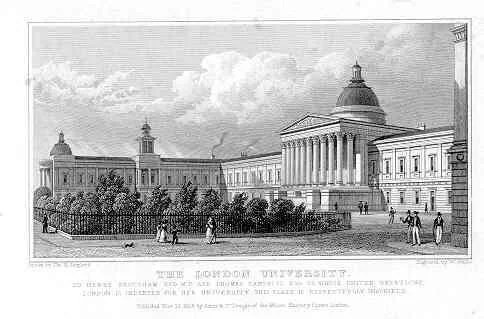
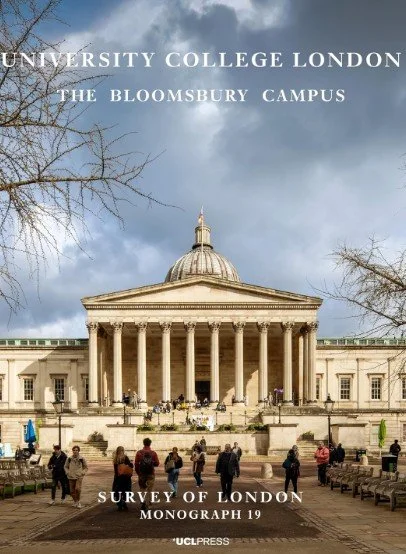
University College London, Gower Street main entrance courtyard.