NWILLIAM FORSYTH: BORN 1872
ADMIRALTY CITADEL
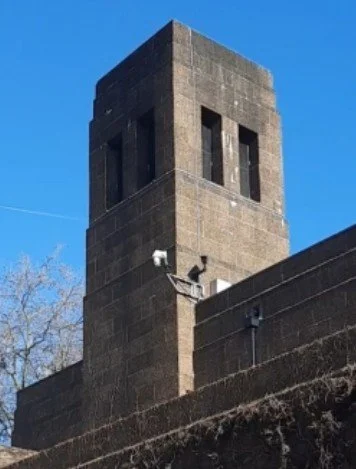
The Admiralty Citadel was built in 1942 as a concrete bomb proof command centre for the Admiralty. Its walls are 8 feet thick. Its roof, covered with grass as camouflage, is 20 feet thick. It is still in use for military purposes, and has been Grade II listed.
Since the Second World War there were various proposals to demolish it as an eyesore. These got nowhere in view of the cost. Instead the more economical tactic of planting ivy over it has been pursued. With the passage of time cities come to love even their oddest excresccences, and in the case of the Citadel it has, with its Grade II listing, become entirely respectable.
BOOKS FROM AMAZON


LIFE
William Forsyth’s most notable London building is the Admiralty Citadel, at the north east corner of St. James’s Park. The foll owing description is reproduced, with acknowledgement and thanks, from the Living London History website at www.livinglondonhistory.com.
Designed by W A Forsyth (1872-1951), Admiralty Citadel was built between 1940-1941 and is the most visible of a network of bomb-proof bunkers and tunnels constructed during the Second World War. Once built, it acted as the command and operations centre for the Admiralty during the war. They had previously been housed in the old admiralty building next door but this was not secure enough against air attack.
On the night of the 16th April 1941 the old Admiralty Building took 3 direct hits. These damaged the board room and South front onto Horse Guards Parade.
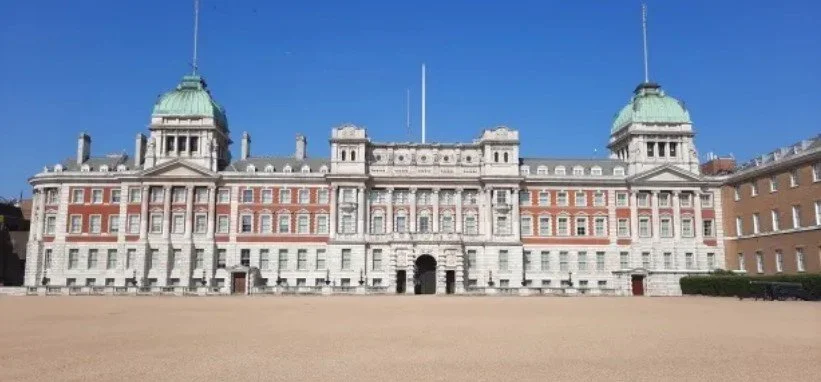
The Old Admiralty Building
The Citadel has 30ft foundations, a 20ft thick concrete roof and has tunnels linking it to Whitehall. Fitted with loop-holed gun emplacements, the Citadel could essentially turn into a siege-resistant fortress in the event of an enemy land invasion.
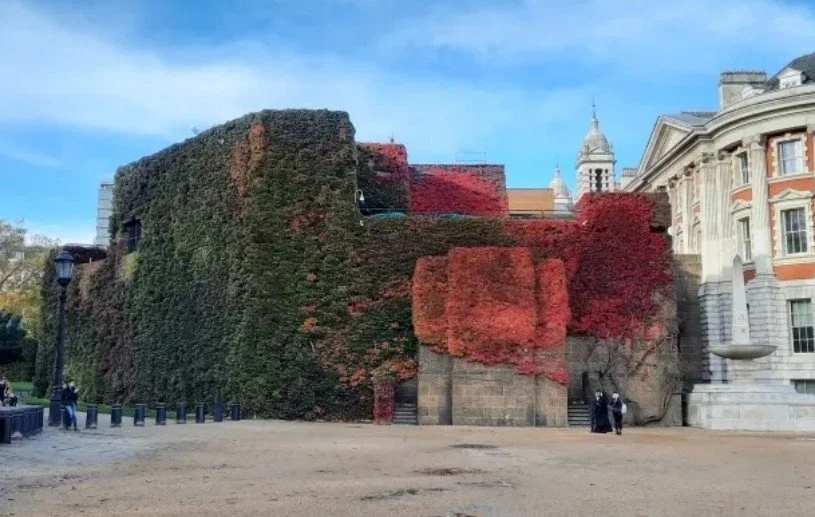
Admiralty Citadel
Secrecy was paramount and, at first, the press were forbidden to even acknowledge its existence. It also has a lawn roof to disguise it from the air. Someone, with security clearance, still has to regularly go up there with a lawnmower to mow the lawn!
Churchill, who spent so much of his time nearby in the tunnels of the cabinet war rooms, described it as ‘a vast monstrosity which weighs upon the Horse Guards Parade’.
What was it like inside during the war? Thankfully, we have a couple of great sources.
In September 1945 Rear Admiral R K Dickson D.S.O. Chief of Naval Information, Overseas Service, spoke for a broadcast about the Citadel and gave us some brilliant insights into what it would have looked and felt like inside during the war. Up until the Cold War, the authorities were actually quite open about what happened here during the war.
Here are a couple of my choice highlights that give you a flavour of the frenetic atmosphere inside the Citadel:
‘If you went down there at this moment you’d find 80 girls working teleprinters to all the naval headquarters in Britain and the Continent’
‘That Citadel is just a maze of machinery and conveyor belts. In one week last year, in secret messages alone, the Admiralty handles over 1,300,000 groups of naval cipher.’
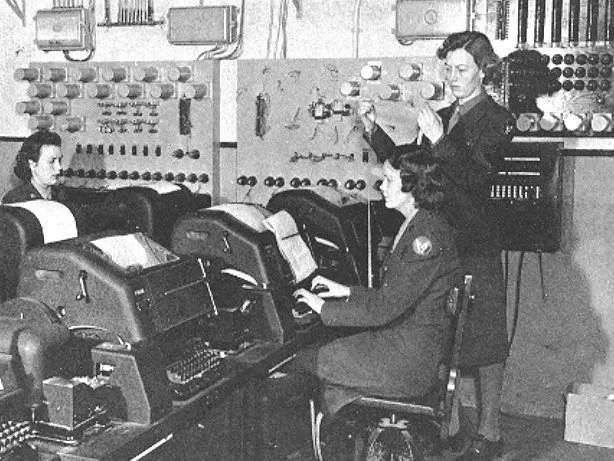
Teleprinter girls in the admiralty citadel.
He said it is ‘air conditioned and lit by daylight lamps, there’s accommodation for the Board and for everyone who’d be needed for the worldwide control of our fleets under continuous air attack on London.’
Beryl Embert who worked there on the teleprinters from 1942-1946 said that it was a ‘hive of industry’. Her week would look like this: ‘Working on one of 3 watches. Our hours consisted of a week of days, 6 days a week 9am – 7pm plus 2 hours traveling, then 2 weeks of night 14 hours every other night, resulting in getting a Sunday off every 21 weeks. Bank holidays and Christmas etc were not existent’.
After the war, the building was considered by many as an eyesore and its future was discussed in Parliament in 1955. MPs called it ‘hideous’ and ‘an offence to the architecture of London’.
It already had some ivy around the outside to make its appearance less harsh but other suggestions to improve its appearance included cladding it in Portland stone, statues of naval figures, or to turn it into the ‘Hanging Gardens of London’. All of these were discounted, mainly on the basis of cost. Due to its nature, demolition would also have been a very difficult and expensive task.
In the end the Admiralty communications centre was set up here and the building became known as HMS St Vincent. It was, what is known as, a ‘stone frigate’: an on-shore naval base. In 1998 it became the MARCOMM COMCEN (St Vincent) and it is still used by the Ministry of Defence today.
It is still predominantly referred to as the Admiralty Citadel and is often pointed out during the Trooping of the Colour. It is Grade II listed and described by English Heritage as ‘ a cubist fortress’ and a ‘strong, utilitarian structure which reflects its real purpose’. The ivy means that the building’s appearance shifts dramatically through the seasons.
So next time you are at Horse Guards Parade look in the opposite direction to most other people and admire the citadel in all its stark glory.