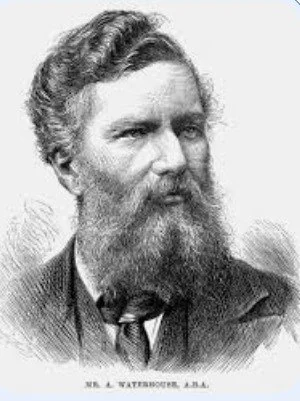
ALFRED WATERHOUSE: BORN 1830
Alfred Waterhouse RA was particularly associated with Gothic Revival architecture, although he designed using other architectural styles as well. He is best known for his designs for Manchester Town Hall and the Natural History Museum in London. The latter is an extraordinary exercise in neo-gothic fantasy. It has a 680 foot long facade fronting the Cromwell Road. In the centre of the facade is a spectacular entrance flanked by two elaborate towers. The scale is emphasised by the very wide steps up which you have to ascend to reach the monumental front door. True Victorian grandeur.
BOOKS FROM AMAZON

LIFE
The following article was reproduced, with acknowledgement and thanks, from the Victorian Web website at www.victorianweb.org. It was written by Jacqueline Banerjee.
Alfred Waterhouse was born in Aigburth, Liverpool, the eldest of the large family of a cotton broker and his wife, both Quakers. A northerner by birth, he was to have his first big success in the north, with his 1859 design for the Manchester Assize Courts, and to design his "High Victorian secular masterpiece" there nearly ten years later â Manchester Town Hall. But from the very beginning he was set to be much more than a provincial architect. He was educated at a Quaker boarding school in Tottenham, on the north-east outskirts of London, and his Quaker connections from that time forward were to be important in launching his career. Despite an early inclination towards drawing and painting, he was articled to the Quaker architect P. B. Alley in Manchester, but again this was no small regional practice. Alley was in partnership then with the leading Manchester architect, the neo-classicist Richard Lane. Ten months' travel in Europe completed the young Waterhouse's sound and promising architectural education.
The young architect had only been in practice four years before winning the competition for the Manchester courts, but the 1912 edition of the Dictionary of National Biography finds here, already, his "ability to see almost intuitively yet accurately the inherent possibilities of a site, and the proper disposition of the building to be placed on it," explaining that it was "a well-placed building of a fine and picturesque massing placed on an irregular triangle." After this breakthrough, in 1860 Waterhouse married another Quaker, Elizabeth Hodgkin, the daughter of a Tottenham man, and in 1865 opened an office in London. Two of his brothers had already established themselves there, one as a solicitor and developer, and the other as an accountant. With such a network he was never short of clients, even from the beginning. Indeed, his practice flourished to the extent that he became "the most widely employed British architect in the years from c.1865 to c.1885".
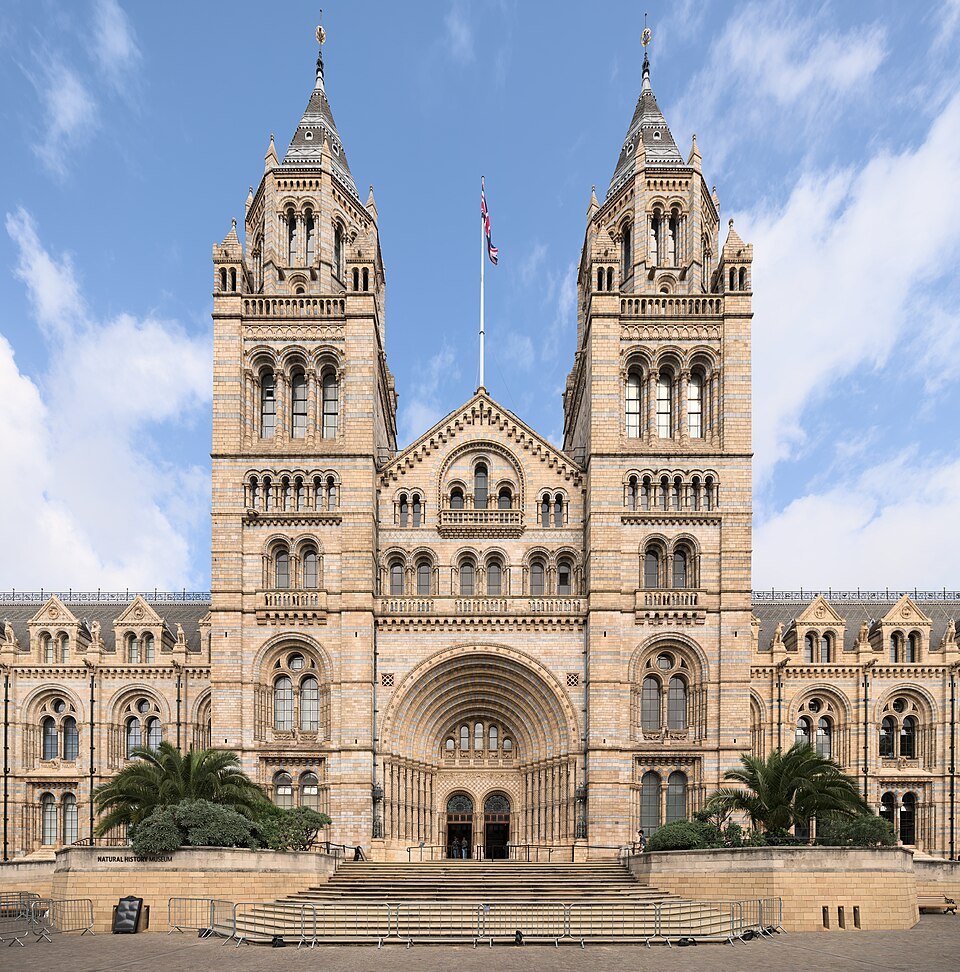
Natural History Museum.
Eventually he would have about 650 buildings to his credit , including the significant triumph of the Natural History Museum in Kensington, a great deal of prestigious work at Oxford and Cambridge, and a whole range of ecclesiastical, commercial and domestic buildings, not to mention institutional buildings like hospitals and clubs. One of the latter, the National Liberal Club, has been described as "perhaps his most complex and effective planning exercise".
Waterhouse was to become the founder of an architectural dynasty, taking his eldest son Paul into practice in 1891; Paul's son Michael would, like both father and grandfather, one day serve as President of RIBA (the Royal Institute of British Architects). A genial, sociable and thoroughly dependable man, a person of strong faith who had become an Anglican in 1887, he was highly respected and left a fortune.
Ruskin, of whom Waterhouse had been an early admirer, had good things to say about the Manchester Assize Courts. Indeed, Kenneth Clark believed that this was the only Gothic Revival building Ruskin praised after 1860, when he called it "much beyond anything yet done in England on my principles". But he had always come in for some criticism and his reputation slumped in the first half of early twentieth century, when his buildings were widely perceived as ugly and tasteless: "Waterhouse had a rather heavy hand and an uncertain sort of eclectic taste," wrote Henry-Russell Hitchcock, more tactfully than most. Even then, however, he was widely praised for his ability to design complex buildings suited to their purpose on any given site. In general, he was recognised as a "Victorian colossus," who, together with the older architects George Gilbert Scott and G. E. Street, was part of "an imposing company who more or less controlled architectural taste for a third of the century". Now he is more warmly praised, even in the matter of taste. For example, one of Gavin Stamp's regrets in his recent Lost Victorian Britain is the failure to rebuild the Manchester Assize Courts after its bombing during the war. "Surely the exterior could have been retained?" he asks plaintively.
It is worth adding that Waterhouse continued to paint and has many fine watercolours, both architectural and landscapes, to his credit, and that, like Scott and Street, he also designed furniture, fittings and so forth. His interest in materials shows in his use of steel frameworks and in his more noticeable trademark use of terracotta, in the interiors as well as on the exteriors of his buildings. Scott's son edited his Recollections after he died, and Street's son wrote a memoir, but Waterhouse had to wait many years for his biography (by Cunningham and Waterhouse). There is no statue of him, despite the fact that Hamo Thornycroft was a protégé of his. There are, however, several portraits, notably one by Sir Lawrence Alma-Tadema, one of his many friends from the art world.
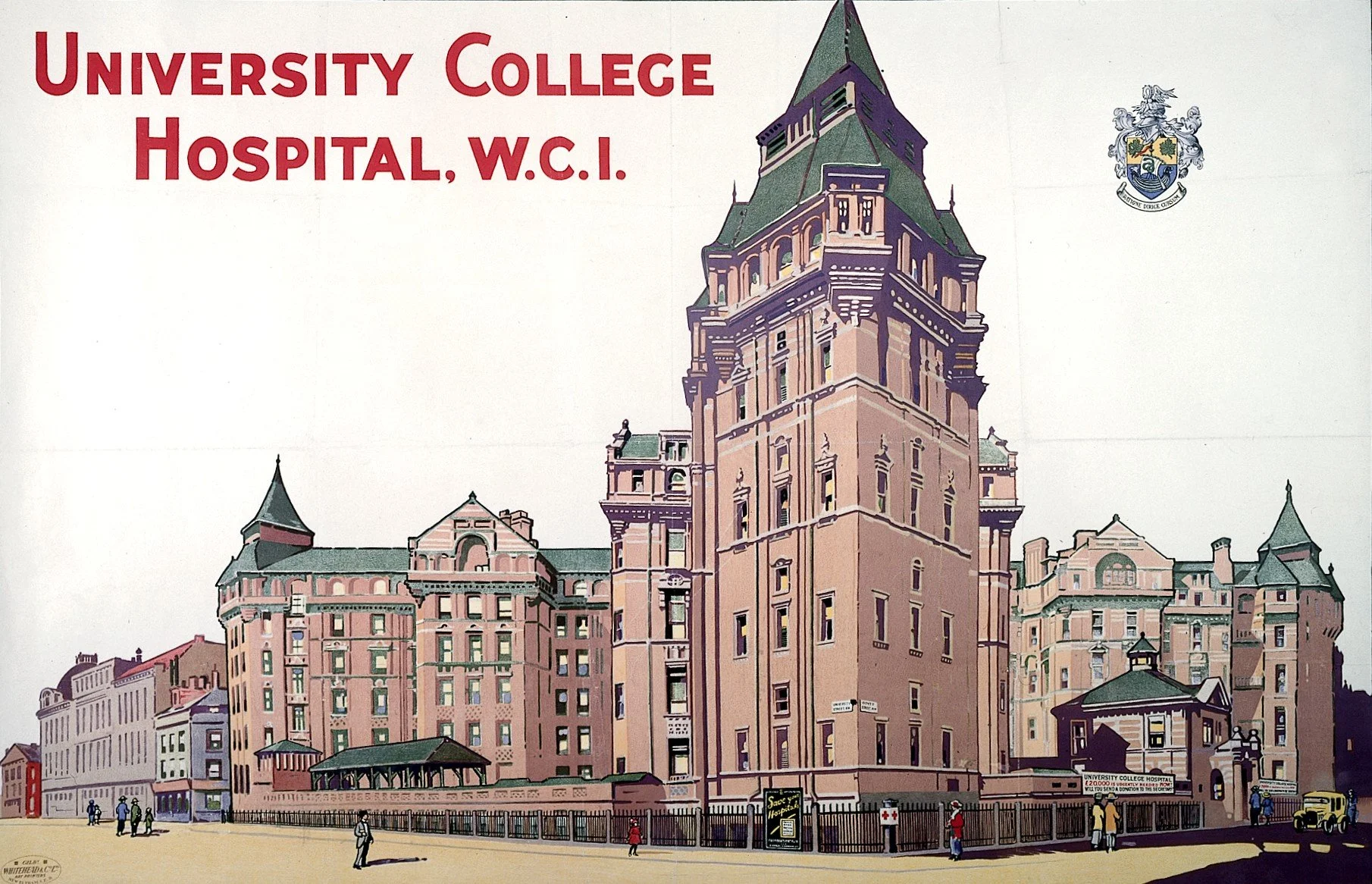
The former Universitty College Hospital, Gower Street.
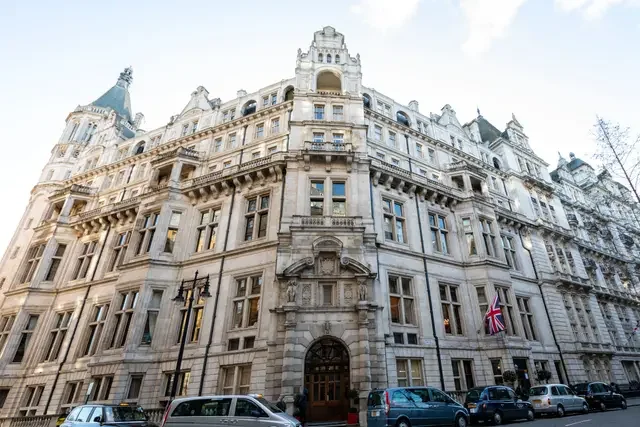
National Liberal Club.