
MICHAEL POULTNEY: BORN 1963
PORTLAND STONE
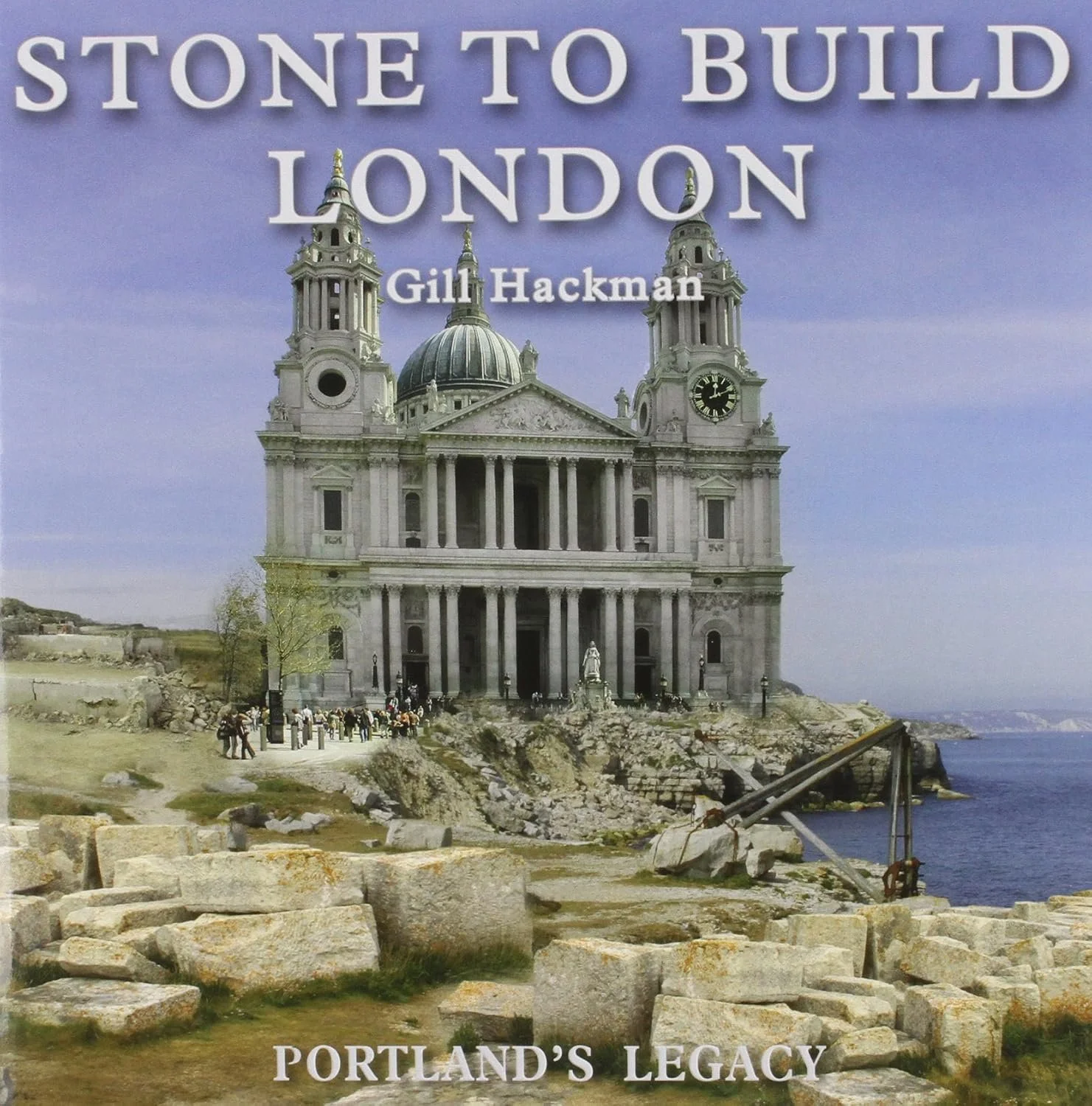
Portland stone, quarried from Portland Bill in Dorset, has transformed London over the centuries. Brought by sailing barge along the English Channel to the Thames, it was used for hundreds of years to build some of London’s most famous buildings - including St. Paul’s Cathedral, Buckingham Palace and the Bank of England. Micheal Poultney is the fourth generation leader of Albion Stone, which mines the stone in Portland today.
BOOKS FROM AMAZON

LIFE
We include Michael Poultney, managing director of Albion Stone as a represtative of the centuries long contribution which Portland stone has made to London. Right back in the 17th century Christopher Wren and Inigo Jones visited Portland Bill to inspect its stone quarries. And nearly a million cubic feet of Portland stone were transported by sailing barge to London to build St. Paul’s Cathedral.
Michael Poultney is the fourth generation of his family to own and manage Albion Stone, his grandfather Harold having bought the business in 1955. He is described thus on the company’s website:
Michael has been working at Albion Stone since 1983. Michael took over the role of MD from his father in 1991. He has overseen a major change in the company from a quarrying business with works in London to now a major mining operation and one of the largest and most technically advanced in the UK.
Michael is on the executive committee, technical committee, Sustainability and ethnical sourcing committee and Quarry forum at the Stone Federation. Michael is also the Mineral Products Association representative at Euroroc, English Stone Forum and the BS545 Natural Stone Committee.
Michael is having a mid-life crisis and entering numerous triathlons, marathons, bike sportive and hiking adventures including climbing Kilimanjaro.
Albion Stone
Albion Stone describes Portland stone thus:
Portland Stone is a naturally occurring oolitic limestone, formed during the Tithonian stage of the Late Jurassic period, around 145 million years ago. In the shallow, warm seas of that era, layers of calcium carbonate, shell fragments, and fossil deposits gradually accumulated on the seabed. Over millions of years, these sediments were compacted and cemented into solid limestone through natural geological processes. Its distinctive composition of tiny spherical grains, known as ooids, combined with fossilized shells, gives Portland Stone its subtle texture and character. While the basic colour of the stone is remarkably consistent, variations in shell content and bed texture create gentle differences in how light interacts with the surface, making each block uniquely beautiful.
And the Albion Stone shift from quarrying to mining method is described in Wikipedia thus:
Jordans is part of the Inmosthay Quarry in the centre of the island, which also includes Fancy Beach. The quarry has been worked since the late 19th century. Albion Stone leases the southern section from The Crown Estate and purchased the northern part of the site in 2006. The majority of the southern reserves lie under the grounds of the local cricket club. To avoid disturbing the site at surface level, the company has applied and received permission to extract the stone using mining rather than quarrying techniques. The reserves to the north will be quarried using the diamond bladed cutting machines, hydro bags and wire saws to shape the blocks. This process avoids the use of dusty and noisy blasting as the primary extraction method, thereby protecting the surrounding environment, which has been designated as a Site of Special Scientific Interest (SSSI).[8] Albion Stone PLC now extract all their stone through mining which dramatically reduces the impact on the environment and local residents. Jordan's Mine is currently the biggest mine on Portland.
Mining in Portland is done by using a room and pillar method. The mine is advanced by extracting the stone using an abrasive tool chain cutter mounted on a machine. Slots are cut into the top, bottom, sides and middle of the stone. A flat steel pillow is inserted into the middle cut and slowly inflated with water. The stones are gently broken off at the back without placing any stress on the resulting blocks. This method of extraction is significantly more expensive than blasting, but results in a higher yield thereby saving valuable reserves for future generations. The environmental benefits are substantial as mining significantly reduces the impact on wildlife and the local community with reduced noise and dust.
Portland stone naturally lies beneath a very hard, coherent layer of Purbeck limestone known as the "cap" stone. In traditional open-cast quarrying, this layer is blasted away as waste. In underground mining, engineers purposely cut the tunnels directly underneath this layer so that the rigid, undisturbed cap stone acts as a solid, natural ceiling.
Traditionally small diameter holes (35 mm) were drilled horizontally under each rock and charged with a small quantity of gunpowder, chosen because of its relative non-shattering properties. When fired the gunpowder produced a "heave" which dislodged the rock from its natural bed, hopefully undamaged. Stone was cut using plugs and feathers, where a series of short, small diameter (typically 30 mm) holes are drilled in a line where a cut is to be made. One plug and two feathers were inserted into each hole and each plug is hit in turn with a sledgehammer until the stone yields to the extreme tensile stresses produced. Most stone is many times weaker in tension than in compression, plugs and feathers utilise this fact. Stone tends to split much more easily parallel to bedding planes (called graining) than perpendicular to them (called cutting).
Portland stone in London
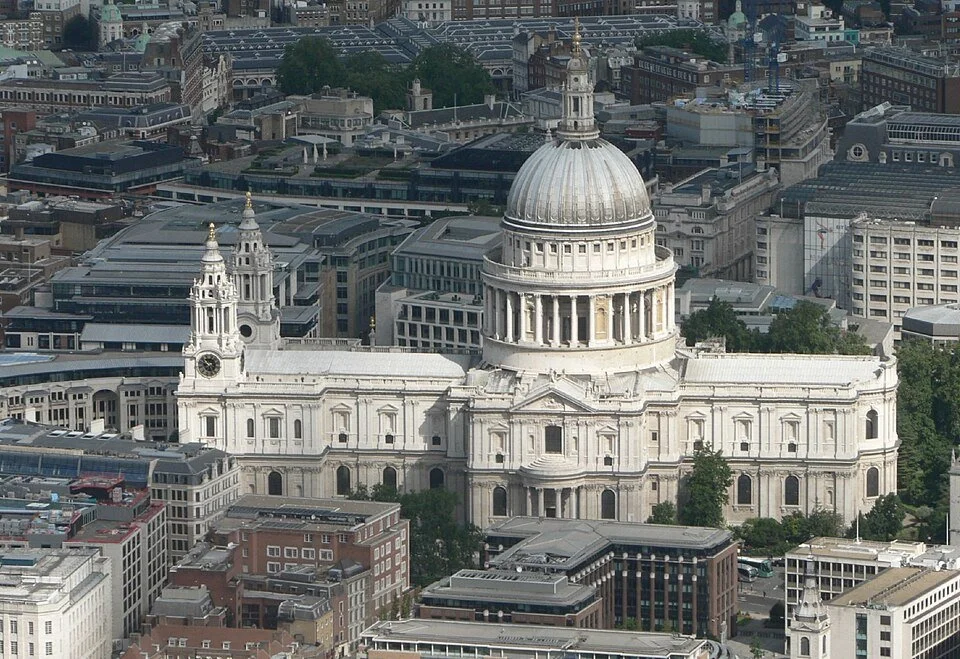
Portland stone was used to build the Palace of Westminster in 1347, the Tower of London in 1349 and the first stone London Bridge in 1350. Exeter Cathedral and Christchurch Priory, also constructed during the 14th Century, are built of Portland stone. Its superb characteristics have ensured a popularity amongst masons and architects that has endured ever since. The East side of Buckingham Palace, the official London residence of King Charles III, including the balcony, was faced with Portland stone, first in 1854 and again in 1913. The Victoria Memorial (unveiled 1911) is also made of it.
Inigo Jones (1573–1652) used Portland stone to build the Banqueting Hall in Whitehall in 1620. Sir Christopher Wren used nearly one million cubic feet to rebuild St. Paul's Cathedral and many other minor churches after the Great Fire of London in 1666.