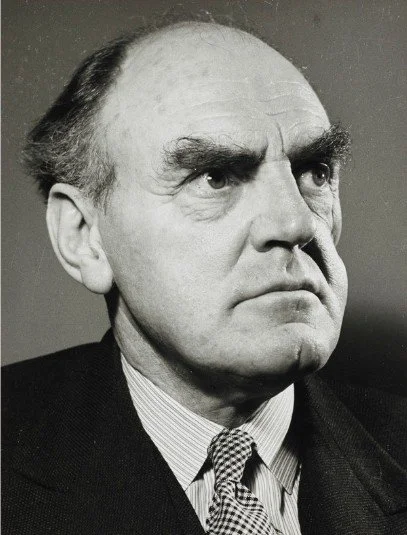
Photo credit: Jane Bown.
JOHN REITH: BORN 1889
FOUNDER OF THE BBC
As the first and extremely forceful Director General of the BBC, Reith for 14 years shaped this national institution. He had a passionate conviction that radio should be publicly owned, should drive forward public appreciation of music and drama, and should be the fount of athorative national and international news. He was persuaded at the age of 50 to step down from the BBC, where he was increasingly clashing with the board of governors. After wartime ministerial roles, from the last of which he was sacked by Churchill, Reith spent the rest of his life an embittered man. A powerful and alarming character, he is well captured in the photo above.
BOOKS FROM AMAZON
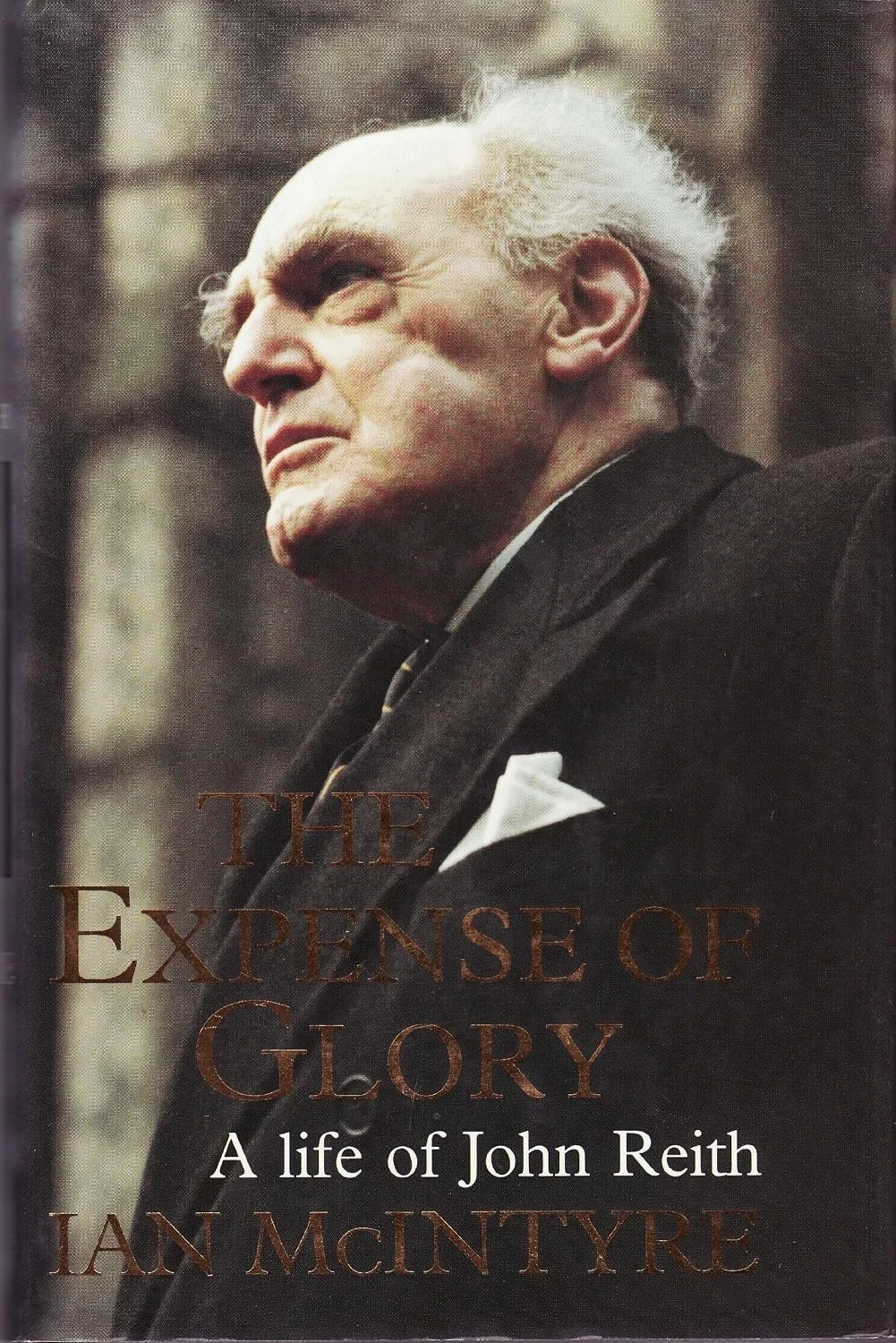


LIFE
The following was extracted, with acknowledgement and thanks, from the BBC website.
Introduction
John Reith (1889-1971) was the founder of the BBC. He was its first general manager when it was set up as the British Broadcasting Company in 1922 and he was its first director general when it became a public corporation in 1927.
He created both the templates for public service broadcasting in Britain and for the arms-length public corporations that were to follow, especially after World War Two. Reith fought off the politicians' attempts to influence the BBC, while offering the British people programmes to educate, inform and entertain.
But in a working life that stretched over 60 years, Reith was at the BBC only 16. This is the story of a towering figure, physically as well as metaphorically, who was never satisfied with life and who said 'What I was capable of compared with what I've achieved is pitiable.'
The Early Years
John Charles Walsham Reith was born on July 20th 1889 at Stonehaven, Kincardineshire. His family were holidaying there from Glasgow, where his father George was a minister in the Free Church of Scotland, later to become the United Free Church of Scotland.
His mother Adah was English and the daughter of a London stockbroker who met George in 1868 at the country home of one of his churchgoers. They married in 1870 and over the next ten years they had four boys and two girls. But it was nearly another ten years before a fifth son, John, was born. By then Adah was 41 and George 47. John (known as Non to the family) was brought up by nurses and rarely saw his father, who was usually too busy.
School
Reith's first school was convenient (it was next to his father's Manse) but hardly appropriate. It was a girls' school where lessons included sewing and singing. He won a prize for his singing – though he later reckoned it was probably because his teacher was one of his father's flock.
In autumn 1896 he moved to the Glasgow Academy, where his haughty manner brought him the nickname Lord Walsham. 'I had enough brains to get through all the classes without effort,' he wrote, 'and so scraped though'. But it wasn't enough for the academy, which, when he got to 15, suggested he left. It's been suggested he was a bully, and he certainly had the build to strike fear in the younger boys – he eventually grew to 6ft 6in. He admitted he was impatient and intolerant, though insisted he was 'entirely moral'.
One of Reith's brothers, Archie, was by that time a Church of England vicar in Norfolk and he recommended a local boarding school, Gresham's, in the market town of Holt. So in 1904 Reith became a boarder 300 miles away from Glasgow, where he was the only Presbyterian and the only Scot. He immediately tried to run away on a bicycle. Eventually, he settled down. He enjoyed the school cadet training corps and was a good enough shot to compete at Bisley. But while he wanted to go to university, his father decided he should learn a trade and become an engineer.
The Apprentice
The five years' apprenticeship had a lasting effect. Some of it good.
Engineering was not a new departure for a Reith. Nor was eventually running a big concern. His paternal grandfather began his career as a wheelwright before becoming a lawyer, railway pioneer and general manager of the Clyde Navigation Trust, one of Glasgow's most important and powerful bodies. Reith's apprenticeship followed a punishing schedule: up at 4.45am to travel from the Manse to the Hyde Park Locomotive Works; and after work and evening classes, he rarely got to bed before 11pm.
As a minister's son, there was a real risk that the other apprentices would make fun of him. So he dressed carefully: an engineer's cap, which he described as being set at 'an aggressive angle', a thick muffler instead of a collar and a threatening expression on his face. Later the cap and muffler were abandoned: 'But the expression,' he wrote, 'seemingly, had congealed.'
London calling
After his apprenticeship, Reith went to London. It was against his father's advice. He warned him he'd come back 'with your tail between your legs.' He was offered £1.50 a week working for a civil engineering firm, S Pearson & Son, extending the Royal Albert Dock. After a month it was increased to £2 a week. Reith saw a future with the firm. He hoped in a few years he could be promoted to sub-agent earning £1,000 a year – until he spoke to the existing sub-agent. He had worked for Pearsons for 15 years and was earning just £250. As Reith put it: 'That was that; my days with Pearsons were numbered, the numbering to be done by me.'
Reith the Warrior
The Young Soldier 1914-1917
The outbreak of the First World War brought an excited tone to the 25-year-old Reith's diary. 'WAR' he wrote in capital letters on 29 July, 1914 – the day after the Austrian Archduke Franz Ferdinand was shot dead in Sarajevo. He admits in his autobiography he'd been looking forward to it for years.
He had been in the cadet corps at school, then joined the Territorial Army, where he rose from the ranks to become a commissioned officer in the 5th Scottish Rifles. When war was declared, he was immediately called up and sent to France.
There his imposing 6ft 6in. height and pair of oversized spurs got him the description 'The officer with the Scotch hat and big spurs'.
His time at the front was marked by rows with some fellow officers. One got him sacked as a transport officer, and there were other examples of outrageous bravado.
He seemed unafraid to put his head above the parapet, preferring to get out of the trench and walk round obstructions rather than keep his head down. On one occasion, he relieved himself in no-man's-land rather than go to the latrines.
A bullet in the face
Reith's luck as a fearless soldier couldn't hold. On 7 October, 1915 he should have had the morning off and he was dressed in his best uniform, a new one because he recently transferred to the Royal Engineers. He knew the outfit would make him more conspicuous, but agreed to accompany his major to inspect overnight damage to the trenches. 'The course of my life,' he later wrote, 'was thus casually altered.'
As he examined a mine crater, a German sniper's bullet hit him in his left cheek, shattering the bone beneath his eye and leaving a wound five inches by three.
His first thought was to remember being hit accidentally by a cricket ball at school. Then he saw the blood. As he lay on a stretcher he muttered: 'I'm very angry and I've spoilt a new tunic'. It was the end of his active service. The wound in his face was clearly visible until the day he died.
A job in the USA
Reith was in hospital for less than a month recovering from his bullet wound.
He then renewed contact with his former boss at Pearsons, E W Moir, who was going to America to organise munition supplies. Reith joined him: 'I knew nothing about the manufacture of small arms; but that bothered me not at all.' He worked at the Remington Arms Company outside Philadelphia and developed experience running a large organisation. He ran an inspection team with 30 experts from the UK and 1,500 locally engaged inspectors checking rifles for the war effort.
Playing to the audience
"I was a sort of curio, the first British officer wounded in the war whom the Americans had seen"
Reith's 18 months in the US gave him experience of becoming a public figure. He met leading financiers and industrialists, including John D Rockefeller Jnr.
His celebrity status was cemented when he was invited to address the St Andrew's Society of Philadelphia. He made a barnstorming speech that he described in a letter to his father as 'a whole lot of rot about glens, forests and straths'. But his audience was ecstatic and when he finished one of them rushed to the piano and started playing God Save the King.
More invitations followed in which he promoted the British war effort using his experience as a British officer wounded on the front line. He spoke at Princeton University, and Lafayette University awarded him an honorary MSc, a recognition he asked his parents to get into the Glasgow Herald.
However, when the US entered the war in 1917, the Remington factory was turned over to producing guns for the American government and Reith's happy time across the Atlantic had to end.
Reith in Love
The untold story during Reith's lifetime was his deep affection for a younger man, Charlie Bowser, whose family lived near Reith in Glasgow. There is no clear proof that Reith was gay, although Reith's biographer Ian McIntyre suggests he was.
When their relationship ended, Reith destroyed many of the relevant sections of his diary and got rid of Charlie's letters. But even the expurgated recollections tell of times when they swam naked together, shared a bed and kissed.
And if people today are less likely to take a moral stand on LGBTQ matters, they might be less indulgent about the way Reith used his influence to get the young man jobs. He even proposed him for an OBE.
Brief encounters
Reith was repressed. He admitted that himself. When he was 20 he had a brief romance with one of his father's congregation in Glasgow, a 15-year-old girl, May MacQueen. Dr. Reith was keen on a match: 'Father announced that he would awfully like May for a daughter-in-law, a hint which I shall not take.'
During a church picnic he kissed her, though he remembered 'it was awkwardly done'. Shortly after came 17-year-old Cissie Murray. 'Very pretty' he described her and they would meet once or twice a week. This relationship didn't even run to an awkward kiss. His recollections, dictated to a secretary in 1929, said he felt no sexual attraction towards Cissie, or to any other girl, and 'as far as I was concerned, she might have been a boy.'
Meeting Charlie
The first time Reith met Charlie Bowser he was 22 and Charlie was 15. 'Very nice little chap' he recorded in his diary entry of May 26th 1912. By September he was describing Charlie as 'Very good looking and awfully pretty eyes'. The attraction wasn't unnoticed.
Reith's family were 'huffy about it' and it led to a row with his brother Douglas. When Reith moved to work in London in 1914, it was not because he wanted to better himself in the capital, but because the Bowsers were moving there. That summer Reith and Charlie spent a weekend in Perthshire where they were like young lovers, carving their initials on a hilltop seat.
On a later weekend in the Highlands they slept together in lodgings - though, it has to be said, two men sharing a bed in those days was seen as a way of saving money on accommodation rather than a sign of sexual activity.
Kisses and Bible reading
When Reith served in France, he carried two photographs in his wallet: one of his father, the other of Charlie Bowser. When Reith first left for the front, Charlie saw him off at Waterloo, and when he returned on leave early in 1915, his schoolboy friend was there again, throwing his arms round his neck and kissing him.
On Reith's last day of leave, Charlie wore his ring and kissed it before giving it back, and Reith promised not take it off until they were together again. A few months later Reith was sent home to recover from dysentery and they visited Scotland together. Reith's diary entry mixes the potentially homo-erotic with respect for the Sabbath:
'Topping to be chasing around together. Church at 11. In afternoon to Monzie Falls and had a ripping bathe, climbing about naked all over the place. Tea at 5 and then read Paradise Lost to mother and C.'
Reith's return to France had echoes of their previous parting. Charlie kissed his signet ring. On the station platform, Reith kissed Charlie.
America's prettiest girls
"She came over and sat very close beside me, but I did not touch her."
Charlie stayed in Britain while Reith worked in the United States in 1916-17. And there, Reith made a new young friend, 14-year-old Jimmy Laws. He took the boy shooting at the Remington factory range and bought him a signet ring for his birthday.
Jimmy had a sister, a second year university student called Jeanette 'the prettiest girl I have seen in this country by a very long way' wrote Reith. 'Is, moreover, clever'. But that wasn't enough for him 'though I may be very fond of Jeanette, she does not enter into the picture compared with him [Charlie]'.
One evening he notes, almost romantically, it was 'a very nice starry night and a full moon'. But when Jeanette came over and sat close to him, he didn't touch her. 'I do not know whether she expected me to kiss her or no,' the 27-year-old Reith told his diary.
It was just as well he maintained this restraint with another girl he met in the States. He described Betty Stewart as 'ravishingly pretty', 'fascinating' and like a 'fairy princess'. He thought she 'put Jeanette in the shade'. Reith taught Betty to drive his car, gave her a gold bracelet and took many photographs of her. Betty Stewart was 12 years old.
Reith Back in Britain
In August 1917 Reith, still a serving officer, returned to Britain from the US. It took time to find a suitable posting but eventually in 1918 he began work in Sussex with the Royal Marine Engineers, building an underwater hydro electric barrage across the Channel.
There were 1,800 men under him, including 20 officers. He was also able to see more of Charlie Bowser. But their relationship was about to get more complicated. The uniformed driver of his commanding officer was a local woman, Muriel Odhams, of the publishing family. And Reith took a shine to her. The result was extraordinary.
After the war ended in November 1918 Reith and Charlie took a house together but there were increasingly three in the relationship. Reith was fond of both Muriel and Charlie – and Charlie was fond of Muriel and Reith. One of their first rows in their new home was when Reith and Charlie talked about marriage. Reith said he'd never thought about it, 'being satisfied with my relationship with him'. Charlie, on the other hand, hoped he would marry. Reith's reaction: 'I knew that marriage and our friendship was not compatible.'
Thoughts of marriage
In spite of his row with Charlie about marriage, Reith was obviously thinking about it. A letter from his father offered advice – though the stern minister's words were clearly not those of a romantic: 'Does the girl you are attracted to come of healthy stock, and is she thoroughly healthy herself?' And there was what Dr Reith called a 'momentous consideration' for his son: 'Will she help me to love and serve my Saviour more than I do?' Reith wrote how he tried to explain his feelings to Muriel:
'I had told her that for years the only people in the world I loved were my father and mother. Then C. came and without making any difference in my love to the old folks I loved him more than all the world. I said that now without lessening that, another love had come.'
Kissing and telling
Reith clearly had feelings for Muriel. But so did Charlie. Bizarrely, when Charlie confided he was in love with Muriel, Reith noted 'I was awfully pleased'. But it was Reith that Muriel loved and he recalled one evening he spent with her using words worthy of a romantic potboiler:
'She put her arms round my neck and held me ever so close and I said “Kiss me darling.” So she put her lips to mine and then away and then back again and we kissed each other. Her lips were trembling and I was shaking all over.'
Naturally all this was immediately relayed to Charlie when Reith got back home and this time it was Charlie who was 'awfully pleased'. Or maybe not. On another occasion, Charlie saw Muriel with her hair down and was overcome with emotion. He went to tell Reith:
'He came into bed beside me; said that he wanted to cry but it wouldn't come. Next day he said after I'd gone to sleep he had “sobbed his wee heart out”'
The Proposal
Little wonder Muriel's parents were uncomfortable with the threesome. Even the day in April 1919 that Reith finally proposed, they went walking as a trio. The proposal seems to have been a choreographed pas de trois. First Reith sent Muriel out on her own while he discussed his proposal with Charlie. Then he sent Charlie to catch up with Muriel and tell her to wait for Reith.
Charlie retreated while Reith proposed and after she said Yes, Reith returned to Charlie. It must have been a big emotional release. He put his arms round Charlie, kissed him and broke down in tears: 'I felt as if I had left him in some way'.
The Man from the Ministry
Reith's engagement was a long one, partly because the day after proposing to Muriel, the now-promoted Major Reith was ordered to a new post on Salisbury Plain, to work on a housing scheme for soldiers. It was his final posting in the Army. In August 1919 he started work as a civil servant at the Ministry of Munitions.
His job as assistant director of ordnance supply was to oversee the end of contracts with arms suppliers. Unofficially he also tried to get Charlie a job there. 1919 ended sadly for him. His father died in December and as Reith looked on his body, he remembered one of the last things Dr Reith had said to him: 'I asked God to help me live pure and straight, and to dedicate myself to Christ and be born again'.
Jobs for the boy
"Some of them did not wear their traditional and symbolic boaters"
As for much of his later life, Reith's job at the Ministry wasn't satisfying him and he looked for another. One was in India. But in 1920 Reith settled for work nearer his old Glasgow home: a job with the leading engineering firm William Beardmore and Co, running its factory in Coatbride. One of his last tasks at the Ministry of Munitions was to make sure Charlie got the job he was leaving.
Not only that, he later wrote to his old Ministry boss to ask him to put Charlie's name forward for an OBE. The string-pulling continued. Once he was running the Beardmore factory, he offered Charlie a job working with him. Charlie came north and the two men took lodgings, sharing a bedroom and a sitting room in Dunblane. Meanwhile Muriel was still living with her parents in Sussex and complaining to Reith about when they would be married.
As a boss Reith was no-nonsense. He ordered Beardmore foremen to start wearing bowler hats again – a traditional symbol of their authority. He introduced clocking on and said if men didn't like it, they had a week's notice to quit. But he also arranged dances and lectures for staff, and entertained senior figures on Coatbridge council to persuade them to allocate some of their council houses to his workers.
The end of the affair
"The girl is not good-looking at all but is cheery and probably a good sort"
With Reith engaged, he must have thought it was a good idea to get Charlie fixed up too. In April 1921 he arranged for him to meet a girl called Maysie Henderson. Reith did not think her good-looking, but financially, she was a catch. She had an income of £20,000 a year – that's more than £600,000 today. Charlie liked her too. But as the two grew closer, Reith became more jealous.
He started describing Maysie in his diary as "the Henderson girl"; later she became "Jezebel". In July 1921, three weeks after Charlie proposed to Maysie, Reith and Muriel married at her home near Brighton and went to live in Dunblane. The relationship with Charlie did not survive a year. An increasingly resentful Reith threw a 25th birthday dinner for Charlie in December, and did not invite his fiancée.
She seems to have had her revenge. She married Charlie in March 1922. A couple of weeks later Reith received a letter from him ending their relationship. It left him thunderstruck. From then on he would avoid his old friend; and the bitterness he felt lasted for the rest of his life.
This is the BBC
In March 1922 Reith left William Beardmore & Co. for London. Although he had reorganised the factory, it had failed to win the orders he was expecting and was virtually closed down after he left. According to Reith's daughter Marista in her book My Father, it was a sign he was more interested in changing things internally than understanding what customers wanted.
Once in London, Reith dabbled in politics. He was not a Conservative, but he did work on behalf of Unionist Tory MPs who wanted to maintain the wartime coalition under the Liberal Prime Minister Lloyd George. He met the Conservative Unionists' leader, Austen Chamberlain, and Lloyd George, who said Reith ought to be in Parliament.
But his place in history came when he saw an advertisement in The Morning Post for a general manager for the British Broadcasting Company. The company was being set up by a consortium of British radio manufacturers to produce programmes that could be heard on their wireless sets. Reith's preparations for the job were amateurish.
Only after he posted his application at his club did he check Who's Who? to look up the man he was applying to. He then had to persuade one of the club staff to retrieve the envelope from the locked letterbox so he could re-write the application, and tell the Aberdonian Sir William Noble of his own Aberdonian ancestors. As for the interview, Reith did little preparation other than prayer:
They didn't ask me many questions and some they did I didn't know the meaning of. The fact is I hadn't the remotest idea as to what broadcasting was. I hadn't troubled to find out. If I had tried I should probably have found difficulty in discovering anyone who knew.
Still, his prayers were answered. The next day, he was offered the job, for £1,750 a year.
The cast enters
The new company was due to start on Monday January 1st 1923. The workaholic Reith was at its office in Kingsway, London, at 9am the previous Saturday. Half an hour later, the company secretary turned up in silk top hat. He was called Major Anderson. It was the first time Reith had seen him but immediately he made his first executive decision: "I saw at once that he would never do."
Reith's first appointment was a personal secretary, one of a long line of intelligent women who would work for him: Isobel Shields went to Girton College in Cambridge and was recommended by Lloyd George's secretary Frances Stevenson (Stevenson was also Lloyd George's mistress and later wife).
As for the job of Reith's deputy, 'if things had been otherwise' he wrote, he might well have appointed Charlie Bowser. Instead it went to a recently-retired Rear Admiral, Charles Carpendale. The Chief Engineer's job went to Peter Eckersley, a former wireless equipment officer who had been working for Marconi. Eckersley was far more experienced in broadcasting than Reith. He had been in charge of both engineering and programme-making at Marconi's experimental radio station at Writtle in Essex, 2MT.
The new Caxton
The BBC that Reith was setting up was all his own work: he compared himself with William Caxton who introduced the printing press to Britain in the 15th century. As he wrote in his autobiography Into the Wind, he had been given a free hand by Sir William Noble, the director who interviewed him:
"We're leaving it all to you. You'll be reporting at our monthly meetings and we'll see how you're getting on." Leaving it all to me. I thought of what that "it" involved. He misunderstood my silence. "That's all right, isn't it?" Quite all right.
There was much to organise. As well as appointing staff, there were broadcasts to organise. Big events of 1923 included opera from Covent Garden and the wedding of the Duke of York, later George V. Reith won the support of the Dean of Westminster to broadcast the marriage service, but the Chapter of Westminster Abbey vetoed it.
He also hoped to broadcast the Remembrance Day service from the Cenotaph. Again his efforts were rebuffed. But he did get to broadcast speeches from the Lord Mayor's Banquet in November 1923; and he received an invitation to the banquet. He turned it down, though: 'on discovering that my place was set in a sort of housekeeper's room.'
London Calling
Reith's ability as a manager who could make quick decisions without bureaucracy is illustrated by an incident not long after the BBC started broadcasting. Its call sign in those days was 2LO (LO was London and the Post Office had 1LO). Broadcasts would begin with the announcer saying: 'This is 2LO, the London station of the British Broadcasting Company. 2LO calling.'
An American called H M Pease was on the BBC board and one day asked Reith: 'Why don't you drop all that rigmarole about 2LO? Why not just London Calling?' Reith wasted no time: 'I went across to a telephone; gave the order to Burrows [Arthur Burrows, the BBC's first announcer] for immediate implementation everywhere. The Post Office must have noticed it; nothing was said. London calling'.
A money-spinning idea
One of the problems Reith had to sort out for the BBC was how to publish its schedules. The newspaper owners were wary of this newcomer and had already limited its ability to broadcast news to protect their interests. They believed the BBC's schedules should appear as paid advertising. The Director General decided to face them down.
Gordon Selfridge, of department store fame, booked regular advertisements in the Pall Mall Gazette and offered Reith to include the schedules in his adverts. Far from the BBC damaging the Gazette' s sales, its circulation went up. The popularity of the schedules gave Reith the idea of starting the Radio Times – he even came up with the name.
When it first appeared in September 1923 it was a huge success and its print run of 285,000 could not meet the demand. It was such a money-spinner that the BBC board suggested Reith had a share of the profits – a proposal that could have quadrupled his salary. But the moralist Director General refused, explaining: 'the trade had put me in office; expected me to look out for them; there was a moral responsibility to them. I would have thought it hardly proper to accept the money."
Special requests
While money was far from Reith's prime consideration, he did seem to glory in the status of his job. On one occasion he invited the Archbishop of Canterbury, Dr Randall Davidson to his flat in London. The Archbishop said he liked piano music, so Reith rang up the BBC's director of music Stanton Jeffries.
A short time later, Jeffries playing Schubert's Marche Militaire came over the radio for the Archbishop's benefit. Another admirer was the Conservative Prime Minister Stanley Baldwin. At a private dinner, Baldwin spoke about a perk of being PM: he had been driven to an engagement on the wrong side of the road to avoid the London traffic. Reith topped that.
He told Baldwin he could pick up the phone in his study, give two simple orders to the BBC and his voice would be transmitted to the homes of several million people around the country. 'He agreed that that was more impressive than his car exploit.' A later Archbishop of Canterbury, Dr Cosmo Lang told Reith: 'Whoever holds your job is, or should be, the most influential man in the country.'
From Company to Corporation
However you looked at it, Reith's running of the British Broadcasting Company was a success. The number of listeners and licence-fee payers was rocketing, the wireless manufacturers were making money and the company was becoming established as part of the British way of life. But the BBC had a licence to operate only until the end of 1926 and there was no guarantee that things would carry on as before.
Reith's big fear was what he called 'the brute force of monopoly' might disappear and competition would force down standards. He believed in public service broadcasting. He did not invent the expression 'entertaining, informing and educating' – that was the American broadcasting pioneer David Sarnoff in 1922 – but he made it so central to the way he ran the BBC that his name became a byword for it: Reithian. Pure entertainment was a prostitution of broadcasting. Instead he saw it almost as an extension his father's pulpit. Without a broadcasting monopoly…
…The Christian religion and the Sabbath might not have had the place and protection they had; the place and protection which it was right to give them…. One day in the week clear of jazz and variety and such like…Almost everything might have been different. The BBC might have had to play for safety; prosecute the obviously popular lines; count its clients; study and meet their reactions; curry favour; subordinate itself to the vote…
Reith's passionate belief in public service broadcasting led him to propose an innovation to the running of the State. He put forward the idea of a public corporation, run at arm's length from the government, but supervised by a board of governors. The corporation would still be run day-to-day by its managers, but instead of representing a company's investors in the drive for profits, the governors would put the public interest first. It was a model later taken up by the post-Second World War Labour government in its nationalisation programme, but it still worked best at the BBC where Reith established its traditional independence.
The General Strike
The BBC's role in the 1926 General Strike, when it was the only independent voice available to the nation, is told on other pages of this BBC website. But the result firmly established the broadcaster – still the British Broadcasting Company – as the impartial voice of news. The Director General John Reith was central to that reputation.
Because of his warm relationship with Prime Minister Baldwin, he wrote a direct appeal for BBC independence, against ministers including Winston Churchill who thought it should be a government mouthpiece. Baldwin told Reith to appeal directly to the Cabinet committee dealing with the strike, chaired by the Home Secretary, William Joynson-Hicks - Jix as he was known. He wrote about the meeting:
'Jix said he had been authorised by the Prime Minister to say that he preferred to trust the BBC, in particular Mr Reith the managing-director, to do what was best; he added that he himself entirely agreed. Churchill immediately and emphatically objected.'
During the strike Reith vetted almost all the bulletins, while also dealing with the political aspects. He decided to refuse the Archbishop of Canterbury's request to appeal for an end to the strike; but allowed reporting of TUC statements. He helped Baldwin write a speech to the nation, which was delivered from Reith's home in Westminster.
And when the strike was called off, it was Reith who wrote a homily about it. It ended with Blake's poem Jerusalem and as he read the words, an orchestra theatrically played behind him. For the final verse, a chorus swelled up. Later, Reith mused on whether he should have let Churchill get his way and commandeer the BBC:
My conclusion was that it would have been better for me, worse for the BBC and for the country.
Arise Sir John
Reith's work on behalf of the BBC was honoured in a knighthood in December 1926, just as the British Broadcasting Company was about to become the British Broadcasting Corporation. But the man who had turned down an invitation to the 1923 Lord Mayor's Banquet because his seat wasn't good enough, was again filled with his own importance.
He was dismissive of his 'ordinary' knighthood and thought he deserved a higher rank – even the highest award of chivalry, Knight of the Garter. So when the letter putting forward his name for a knighthood arrived, his reaction was underwhelming:
I should have been surprised if it had not come, but was by no manner of means pleased. I am not keen on titles anyhow and a KG would not have been too much for what I have done…. An ordinary knighthood is almost an insult.
Reith could not decide whether to accept and he only did so after receiving a phone call from Downing Street telling him to make up his mind.
Corporation Man 1927 - 1938
It's a measure of how highly the directors of the British Broadcasting Company rated John Reith that they supported his proposals for a public corporation – even though it meant making themselves redundant in favour of governors on January 1st, 1927.
Unfortunately for Reith, those former directors had given him a much freer hand to operate than his new ministerially-appointed board - some even wanted to meet daily. Reith distrusted the new chairman, Lord Clarendon, and called him behind his back 'a silly ass'. He was even more vehement about another governor, Ethel Snowden, wife of Philip Snowden, the former Labour Chancellor of the Exchequer: "a truly terrible creature, ignorant, stupid and horrid."
The feeling was mutual. Mrs Snowden's description of Reith was: "a man whose overwhelming egoism is as distasteful as his character and ability are overestimated." Reith stayed at the helm of the Corporation for another eleven years, but the organisation he had created – and in many ways was still creating – was never the same for him.
A father at last
Reith was nearly 39 and had been married six years when, in 1928, he and Muriel had a baby boy, Christopher John (they had a daughter Marista four years later). And it was clear only the best would do for their first-born. Reith immediately decided to put his name down for Eton; and asked his friend the Archbishop of Canterbury, Randall Davidson, to perform the baptism.
For a son of a Scottish Manse to ask a Primate of the Church of England to perform the ceremony raised some eyebrows. A couple of years earlier he had turned down an invitation to become a church elder at St Columba's in London because it was part of the Church of Scotland; he explained he wanted to keep his links with his father's denomination, the even more strictly Protestant United Free Church of Scotland.
Now he wanted his son to be baptised into what St Columba's minister reminded him in a letter was 'the Anglican branch of the Catholic Church'. Reith, not for the first time in his life, was impressed by the trappings of British society. With pleasure he observed after the baptism at Lambeth Palace that 'The Archbishop had on his proper robes with the GCVO ribbon and looked very fine.'
The BBC announcer
Reith was no behind-the-scenes administrator. When it came to historic events, like the General Strike and the 1936 Abdication speech of Edward VIII, Reith himself took to the microphone. Another occasion was the 1929 election, which was won by Labour's Ramsay MacDonald. Reith had been in contact with the parties beforehand about their election addresses.
'MacDonald was ineffective', he noted, though Prime Minister Baldwin impressed him by asking about the social make-up of the radio audience. The senior Conservative Neville Chamberlain was more cavalier; and Reith in his memoirs complained he didn't take the power of broadcasting seriously enough:
"Neville Chamberlain on arrival at Savoy Hill said he was going to make a poor show – in fact he did – as he had no time for preparation. What more important work could he have been doing during the week?"
But Reith's own election performance turned out to be a let-down. The BBC's election results service had been rehearsed, but during the second bulletin of the evening, Reith announced he would read all the results himself until 1.30am. He hadn't been doing it long when listeners rang asking for the reader to be clearer and to read slower.
The man with the job of explaining this to his Director General was the announcer Eric Dunstan. He later recalled: 'I did my best politely to inform him of the position, but all he said was: "I will not read any slower; I am going on announcing" and he turned his back on me.' A furious Dunstan stormed out of the building. He said afterwards: 'The listening public wants clear and efficient announcing, and this is the announcer's job and no one else's.' Dunstan was replaced the next day.
The Eckersley Affair
Reith's reputation as a hardline religious boss was cemented by events in 1929 involving his chief engineer Peter Eckersley. Popular perception has it that Reith sacked him for an extra-marital affair. It wasn't so clear-cut. Certainly Reith had a religious streak to him; one BBC interviewee in the1920s remembers being asked by the Director-General: 'Do you accept the fundamental teachings of Jesus Christ?' But it was the disapproval of Eckersley's senior engineering colleagues that brought matters to a head.
The 'other woman' was Dorothy Clark, the estranged wife of the BBC's music adviser, Edward Clark. Before their marriage, she seems to have been what is now known as a "wild-child"; the daughter of affluent parents who became an actress and twice got pregnant while on tour. Eckersley first saw her when she was already separated from Edward and was visiting the BBC's Savoy Hill headquarters. Once their affair began, it seems Edward had no objections.
On one occasion he plotted with Eckersley for both to visit Germany on BBC business and take Dorothy with them. Later, the chief engineer got bolder, taking Dorothy on a BBC visit to Brussels and regularly being seen with her at Savoy Hill. Colleagues who knew his wife Stella, were outraged. In January 1929, it was brought to Reith's attention.
Reith acted cautiously. He first spoke to Eckersley, then invited him and his lover to his flat to explain that Eckersley risked losing his job unless the affair ended. Reith's wife Muriel broke the news to Stella, who knew nothing about the romance. The governors were consulted. Ethel Snowden wanted instant dismissal, though the chairman and Reith were more cautious and wanted Eckersley to resign and be reinstated later if his marriage could be patched up. Reith asked for advice from the Commissioner of the Metropolitan Police, Admiral Byng, who was far more hard-line. He said a BBC man was like a policeman and never off duty: Eckersley, Byng believed, should be sacked.
But Reith didn't follow the advice. Eckersley promised to end the affair and offered his resignation. He let Reith decide what to do with it and Reith recommended to the Governors that he should stay. It was a brief respite. In April 1929, Eckersley ran into Dorothy at a party and decided on the spot to leave his wife. The popular image is of Reith pointing to the door like an Old Testament prophet and condemning Eckersley for straying from the paths of righteousness. In fact, when the governors accepted the chief engineer's resignation, they awarded him £1,000 in recognition of his valuable service and kept him on as a consultant for another year.
Eckersley in his memoirs believed Reith, as both a Christian and the head of a national organisation, was entitled to sack him, though he thought a different boss might have been more lenient: ' I happened to come under the control of that rare individual who acts according to his spiritual convictions.'
A new home
During Reith's time, the BBC had three headquarters buildings in London. It began at Magnet House in Kingsway, with the 2LO studios further down the road in the Strand. Soon after in 1923, it began moving operations to nearby Savoy Hill. But as the BBC expanded, it outgrew this too. Reith seems to have been unimpressed by the new Broadcasting House, which opened in 1932.
He wrote – a decade after he left the Corporation - that he had not been happy with it, and had left the development to others. He thought it was too early for what he called 'a comprehensive headquarters for British broadcasting.' The BBC flag first flew above the 'prow' of the ship-like BH on May 2, 1932, but when overseas broadcasting dignitaries visited, the flags of their countries would be run up instead. Impishly Reith wrote:
"To my regret the head of the Russian system never came to London; it would have been fun to have had the hammer and sickle flying over Broadcasting House and hear what some people had to say."
Governing the board
Reith's struggles with his Board of Governors continued for years. The week after Peter Eckersely resigned in 1929, he was surprised how smoothly the governors' meeting went. Then he found out they had been rushing off to the chairman Lord Clarendon's house for an informal meeting without their Director General. 'What a miserable lot they are, ' he wrote. He was also annoyed the Governors would lunch at the Savoy without inviting him.
It was a relief when Clarendon was replaced in 1930 and by that time Reith decided he would prefer to be BBC chairman than Director General. When the Prime Minister Ramsay MacDonald didn't give it to him, he described himself as disgusted. He saw MacDonald at a funeral service shortly after and 'I directed a glare of malevolence'.
The new chairman was a former Commons Speaker, John Henry Whitley who was nervous about working with the fearsome DG. But the Postmaster General Hastings Lees-Smith told him not to be daunted, telling him Reith wouldn't be long at the BBC "because he will end up in a lunatic asylum". He was wrong, but not wildly so. Reith did receive treatment at the Psychological Clinic of Glasgow during his break-up with Charlie Bowser a decade earlier; and and in later life received electric shock treatment for depression. Also, Reith's brother Ernest died in a lunatic asylum.
Getting a reputation
By the 1930s, Reith had an image problem that never left him. It was made worse because – in an age of dictators - it was easy to make comparisons. When Reith took his mother to tea at the House of Commons, the MP Nancy Astor asked if he got his 'Mussolini traits' from her. During a Commons debate in 1936 on the BBC, the Labour MP George Lansbury said Reith "would have made a very excellent Hitler for his country." Another Labour member, Hastings Lees Smith – the former minister who predicted Reith would end up in an asylum – called the BBC 'the nearest thing in this country to Nazi government that can be shown.'
Reith's own comments didn't help. He said he admired Mussolini and talked in 1939 of Hitler's 'magnificent efficiency'. He also had a sneaking admiration for the German broadcasters: 'Germany has banned hot jazz and I'm sorry that we should be behind in dealing with this filthy product of modernity.'
The view from the inside
"We are thoroughly disgusted with the false and malignant statements about the Director General."
During the 1930s, Reith fought off attempts to introduce a staff association in the BBC to give employees a bigger say. One supporter of the idea was Clement Attlee, later to be Labour's postwar Prime Minister. Attlee suggested that Reith ruled 'a little by fear'. But in a comment that shows his firm belief in managerial hierarchy, Reith denied the charge:
"…unless the awareness and respect which a subordinate should feel of and for his chief is to be called fear – the fear a man should have of not doing as well as he might; of letting himself down; of letting his chief down."
In 1934 Reith appeared in front of the 1922 Committee of Conservative MPs. He expected a rough ride from critics about staff relations, based on newspaper campaigns against him. But when challenged, he passed a letter to the chairman, signed by 800 members of staff that was given to him as he left Broadcasting House for the meeting. It read:
"The undersigned members of the staff of the BBC, thoroughly disgusted with the false and malignant statements about the director-general being published in certain newspapers, wish to record their detestation of the newspapers concerned, and to reaffirm their loyalty and gratitude to the director-general."
The committee's critics melted away after that coup de theatre. But then Reith's sense of the dramatic was honed with the BBC's staff amateur dramatic company. The man accused of being aloof from his workforce regularly appeared in its productions. His last role was in 1936 playing a butler in a play performed at the Fortune Theatre in London. The Daily Mail reviewer described Reith as 'looking uncommonly like Boris Karloff at his most sinister'.
Wider Still and Wider
"Usually on holiday when significant events in television took place."
Throughout Reith's time at the Corporation, it continued to expand. His determination meant its radio broadcasts spread to the Empire, too. The idea of an Empire Service was well received by politicians, but they could not agree who would pay the costs. It was Reith who took it upon himself – and the British licence payer – to go ahead without them. What became the World Servjce was later described by the former UN Secretary General Kofi Annan as "Britain's greatest gift to the world in the 20th century." On the first day of the Empire Service, in 1932, Reith personally delivered the opening address. Because of the different time zones, he had to deliver his words live five times over the next 15½ hours.
He was less interested in the development of television. Anthony Kamm, the biographer of television's inventor, John Logie Baird, says that Reith usually managed to be on holiday when significant events in television took place. One explanation is his background in the Free Church of Scotland, where the Word was what mattered and church decoration was kept to a minimum to avoid distractions.
The BBC historian A S A Briggs believes Reith saw television as a threat to society: 'he thought it would really corrupt and ruin the nation and you can't go much further than that.' At the 1937 Coronation of George V Reith declined an invitation to put the BBC in charge of filming. One of his leaving gifts when he left the BBC in 1938 was a television set. He said he would never look at it.
The King Abdicates
"Good evening, Reith. Very nice of you to make all these arrangements."
In 1936 the new King Edward VIII renounced the Throne to marry the divorcee Mrs Simpson. The King wanted to speak to the nation about the affair, but had to wait until the abdication was approved by Parliament. Reith went personally to Windsor Castle, where engineers had set up a microphone for the 10pm broadcast. The former King was grateful: 'Good evening, Reith. Very nice of you to make all these arrangements and to come over yourself.'
Reith made the introduction, calling him 'His Royal Highness the Prince Edward', then slipped out of the chair for the prince to take his place. As he moved in, Edward kicked the table leg with a bang clearly heard over the microphone. Listeners thought it was a sign of Reith's disapproval, imagining the moralistic DG had walked out and slammed the door behind him.
Flight to Imperial Airways
Why Reith left the BBC in 1938 is still a mystery, which even he doesn't seem to have understood. He later called his resignation 'a frightful mistake', though his daughter Marista thinks he was trying to cover up the fact that he'd been pushed out. Reith's biographer Ian McIntyre says he wasn't pushed: he jumped. He'd been announcing for years he wanted to leave. Indeed as the BBC began a new Charter period in 1937, he offered the Governors his resignation so they could begin this new chapter with a fresh face.
Reith's diaries talk about his constant search for new challenges, though the BBC historian A S A Briggs says there were challenges enough in the BBC, had he wanted to take them; like developing television and how to handle mass communication in wartime.
But the facts of his departure are these. He was called to Downing Street early in June 1938 to see the Prime Minister Neville Chamberlain's top adviser Sir Horace Wilson. He offered Reith the full-time job as chairman of the struggling government-subsidised Imperial Airways, 'starting tomorrow if possible'.
Reith had already heard his name linked with the job so wasn't surprised, but he insisted on Chamberlain making the job offer personally. His interview with Chamberlain sounds bizarre. Reith didn't fight to keep his BBC job and didn't argue with the Prime Minister. Nor did Chamberlain 'instruct' him to take it.
"He said he wasn't using that word. So I asked if he wanted me to go. He said again that was maybe too strong but that if I went he would be very glad."
And that was how, after 18 years in charge of British broadcasting, Reith got a new job. It wasn't an order, he could have refused and he didn't even get a peerage or extra money out of it. In his memoirs he wrote: 'I said I was getting £10,000 from the BBC and would not require any increase on that.'
Last days at the BBC
Reith's had hoped his new job running Imperial Airways would not cut all his links with the BBC and he might be appointed a Governor. But the chairman, R C Norman, told him that his presence on the board would be unfair on his successor. The governors also decided he should not help to choose his replacement, who turned out to be Sir Frederick Ogilvie, Vice Chancellor of Queen's University, Belfast.
Reith had wanted an internal appointment, but on the governors' behalf had rung up Ogilvie to see if he was interested. Reith's view of him: 'a man of fine character and outlook; of personal charm…. I was quite sure he was not the man for the BBC.'
On June 30th, 1938, Reith left Broadcasting House for the last time as DG. He had asked to go without ceremony and – as he put it – 'one walked out as quietly as one had walked in'. He carried out one more duty. Along with his secretary and his deputy Cecil Graves – the man he wanted to replace him – they drove to the BBC transmitter at Droitwich in Worcestershire to switch it off at midnight. He signed the visitors book: 'J C W Reith – late BBC'.
There was a postscript to this. A week later, the BBC governors realised Reith had not handed in a written resignation. The chairman had to remind him. In a bitter reply, Reith responded: 'I resign, I shall resign, I have resigned. There it is – in all three tenses…'
Reith in Wartime
Having pioneered broadcast communications between Britain and the Empire, Reith was now the man in charge of linking them by air. Imperial Airways - subsidised by the government, though with private shareholders – flew passengers and mail to the outposts of Empire with its famous flying boats. But by 1938 it was losing ground on worldwide routes to other national carriers like Lufthansa and Air France.
Reith's arrival as chairman and managing director must have come as a shock after his time at the BBC: his first task was to authorise lavatory improvements at Croydon Airport. Did the managing director usually deal with matters like this, he asked? 'Yes, indeed' was the answer. Little wonder he set about reorganising the airline.
Using the BBC as a model, he proposed turning it into a state-owned public corporation through a merger with the other, and more successful, British airline British Airways. Within four months, the government had agreed to his plans. The result was the British Overseas Airways Corporation, better known as BOAC.
War breaks out
Reith's life is characterised by his efforts to take on more responsibilities. Running Imperial Airways was not enough; he was soon trying to join the Territorial Army as well. He was offered command of a searchlight company and was later asked to run a whole searchlight battalion. 'So I was going up in the world', he noted drily. But after war broke out, he took on a much bigger role.
In January 1940, Chamberlain invited him into the government as Minister of Information. Reith was not keen. He felt the Ministry had not been run well and was in 'notorious dispute'. He also felt Chamberlain did not personally want him. Their meeting in Downing Street was unfriendly, he wrote. But just as when Chamberlain had asked him to run Imperial Airways, Reith agreed, with misgivings. 'Tried hard to be pleased about it,' he said of his new job. 'Utterly failed'.
Goebbels's Opposite Number
Being Minister of Information with Cabinet rank brought with it a seat in the House of Commons. Reith was elected unopposed for Southampton, whose sitting MP was given a peerage. He had no party label, he was a candidate of the National Government. He found his ministerial role frustrating. The Ministry of Information was one of a handful of Whitehall departments involved in propaganda and information, and no one was in overall charge. Reith thought it was laughable when people compared him with his Nazi equivalent Dr Goebbels. One incident summed up his problems:
As a matter of the greatest urgency and moment I was requested on March 11 to intensify propaganda in the Scandinavian countries. Just that…. No idea of the reason; I could give no directive as to what purpose the intensified propaganda was to serve. Propagand harder in Scandinavia, boys. They would ask what for; the Minister of Information would say he was sorry, he did not know.
Chamberlain had tied Reith's hands further by asking him not to use his background in the BBC to intervene in the Corporation; or to make broadcasts. During his short time as Information Minister, Reith broadcast only once – to France. The News Chronicle said he sounded like 'an ambitious West End actor impersonating a French university lecturer addressing English students.'
Moving to Transport
By May 1940 the war was going badly for Britain - and for Prime Minister Chamberlain. His fate was decided after a debate in the House of Commons about military reverses in Norway. Thirty of his own Conservative MPs joined Labour MPs in voting against him. On May 10th, Labour's leader Clement Attlee sent word that he could no longer serve in the National Government under the Prime Minister.
Chamberlain resigned that afternoon and made way for Reith's old adversary Winston Churchill. When the new Cabinet appointments were announced, the Information Ministry went to Duff Cooper. When he heard, Reith shook hands with senior colleagues, packed up his belongings and, inside ten minutes, had left the building.
That dramatic gesture almost backfired. Churchill wanted to make him Minister of Transport, but because Reith had left so abruptly, it took until the following afternoon to find him. Transport was a disappointment to someone who relished hard work. His sacked predecessor told him next day that the Ministry, responsible for railways and docks, almost ran itself and there was little for the minister to do.
This was another short-lived job for Reith, but in was in this role that he made his maiden - and only - Commons speech, winding up a debate in secret session. Two weeks, later, on October 2nd, 1940, Churchill moved him again, this time to be Minister of Works, and to the House of Lords. Reith's nine months as an MP was over. He became Lord Reith of Stonehaven, his Scottish birthplace.
An enemy at the gates
Although a government minister and peer, Reith was still missing the BBC. At a Cabinet meeting in November 1940, the Corporation came under attack from fellow ministers including Churchill. Later he wrote about the discussion:
Churchill spoke with great bitterness : an enemy within the gates; continually causing trouble; doing more harm than good; something drastic must be done about them. … I wondered what Churchill would say if I offered to go back to the BBC. I nearly did so then and there; very nearly indeed.; it would have been better for me if I had…
As Minister of Works, Reith again experienced the frustrations he felt at Information: too many other departments fighting turf wars. But he found consolation in his responsibility for postwar development. His intensity impressed his officials. One commented: "The speed at which you move is rather shattering to the average person." He stayed in the job for more than a year, until once again Churchill had a reshuffle. This time he was sacked completely.
The news he was out of government came in a letter delivered by motorcycle courier at his home in Buckinghamshire one Saturday evening in February 1942. When Reith read it, he compared his shock with when he was shot in the First World War. Later he blamed what he called "reactionary" Conservative backbenchers for his downfall, possibly because they feared he wanted to nationalise land as part of postwar planning. Another explanation was that Churchill was trying to keep all three parties in his coalition government happy and the non-aligned Reith had no one to fight on his behalf.
Planning for D Day
Reith hated kicking his heels. Desperate for something to do after Churchill sacked him, he wrote to a friend in the Royal Navy for a job: 'I've only one stipulation,' he said, 'to be kept busy. By busy I mean about three times as much work as you imagine anyone doing.' He was a peer and former minister in his fifties, yet he was given a relatively junior rank: Lt Commander - he said his uniform made him look like his chauffeur.
But his talent for organisation found a use in organising ships and equipment to take part in the D Day landings. He was so central to the planning that he was given the top secret details of the invasion in advance. Almost 2,500 British ships were involved in the June 6th landings and the day after, Reith's boss at the Admiralty congratulated him. The Navy had expected no more than 80 per cent of its ships to be available on the day. Reith had made sure the figure was almost 99 per cent.
A young secretary
During his life, Reith took as protégées a number of younger women. One was a girl called Joyce Wilson from Dunblane, whose family he knew. Reith wanted her as his secretary in the Admiralty, but there was a problem. She was serving in the women's branch of the Army, the ATS, not the Navy and the Army didn't want to release her.
Reith fired off a series of memos that eventually went all the way to the Secretary of State for War, Sir James Grigg. He wrote a blunt note on the file: "I will not have my officers, ATS, shunted about to suit the convenience of John Reith, who somewhat late in life has discovered the art of fucking."
There was no evidence of impropriety and later Grigg gave in. But Reith's relationship with the young woman set tongues wagging. In October 1944, he was invited to a ship launch in Newcastle and asked if Joyce could come too. Generously, the shipbuilders asked if she would like to perform the ceremony. So the young secretary launched the ship, while the wife of an admiral, who was also among the guests, could only look on.
Reith Postwar
After the war, Reith held a succession of jobs reserved for the great and the good, but never did he hold the influence of his BBC years. Instead he regularly complained of being overlooked. His attitude to the BBC remained icy, though with occasional thaws if he was flattered enough by whoever was in charge at the time. And his old thunder returned when the Churchill government decided to end the BBC monopoly and introduce ITV.
War work honoured
Reith left his Navy job officially in December 1944. In the 1945 New Year's honours his work was recognised when he was made a Companion of the Bath (CB), an award given to senior civil servants and military officers. But typically, he still had a moan. The announcement in The Times was in print too small for his liking; and the man who succeeded him as Minister of Works, Lord Portal, had been promoted to Viscount, a higher rank of the peerage than Reith's. 'Shameful', he called it, and blamed his old adversary the Prime Minister: 'Of course he is a friend of Churchill's'.
A letter to Mr Churchill
Churchill lost the 1945 election and in January 1946 Reith wrote to him, with a long letter he said he'd been wanting to write for more than two years. He complained about his 'utter shock' at the way Churchill had sacked him and said that even when he was a minister he was never stretched. 'You could have used me in a way and to an extent you never realised.'
Churchill replied sympathetically. He was 'unfeignedly sorry' for Reith's pain 'which I understand very fully'. He himself had been out of office for eleven years before the war, during which time he had wanted to be involved. But he also told Reith that whenever he considered him for a job, there was opposition because people said he was difficult to get on with. Churchill wrote: 'I am very sorry that the fortunes of war should have proved so adverse to you, and I feel the State is in your debt.'
The job hunter
Reith's postwar jobs included a globetrotting inquiry into Commonwealth communications and chairing a subsequent conference. He also worked – unpaid – compiling the 1946 Reith Report into developing new towns around London. For almost a decade, between 1950 and 1959, he chaired the Colonial Development Corporation and he held a string of directorships. But he really hankered for the big jobs: like running the United Nations or the new National Coal Board. 'Starting up something new is my line' he wrote.
When Lord Mountbatten was appointed Viceroy of India in the run-up to independence, he mourned: 'That is the job I most wanted on earth gone for good' and it had gone to 'the playboy Mountbatten', a 'fraud and a counterfeit'. Even in his sixties and seventies Reith was still looking for a high-powered role.
When Clement Attlee was re-elected in 1950 he wrote plaintively: 'Isn't there some big job you would like me to do? I could do such a lot, you know.' Fourteen years later, when Reith was 75, he appealed to another Labour Prime Minister, this time Harold Wilson, telling him: 'the more difficult the job the better.'
The vacant chair
Reith's relations with the BBC after he left in 1938 were distant. He admitted in 1946 that he had hardly listened to any BBC output since leaving, except for the occasional news bulletin and election broadcasts. When Robert Foot started his first day as Director General in 1942, he received a phone call: 'This is Reith speaking, you really are not up to the job and you should go at once.'
The former DG boycotted the BBC's 21st anniversary dinner in 1943, saying 'the lunch should have been given to me'; and when William Haley got his old job as Director General in 1944, he persisted in calling him 'Bailey' in his diary.
But flattery got Haley everywhere. In 1946, Reith heard the new DG had been saying nice things about him and offered a meeting at which Haley was again complimentary. A short time later BBC engineers installed a wireless and television set at Reith's home; and there was more flattery when he told Reith of plans for annual Reith Lectures.
There could well have been an ulterior motive for Reith's rapprochement. There was a vacancy for the chairmanship. It eventually went to a Labour peer Lord Simon of Wythenshaw and his example should have given Reith food for thought. Simon said he, like the politically independent Reith, had unsuccessfully asked Attlee for a job. But once he joined the Labour Party, Simon got a peerage and became BBC chairman.
The ice age returns
Reith's relationship with the next Director General Sir Ian Jacob, who got the job in 1952, was much frostier. Jacob had never worked at the BBC under Reith, and had been a close wartime ally of Reith's bête noir, Winston Churchill, as deputy secretary of the War Cabinet. What's more, Jacob, like Reith, served in the Royal Engineers, but had achieved a much higher rank. In 1953 Reith and Jacob agreed to have lunch, but it was an uncomfortable affair. Each was determined not to talk about broadcasting and their lunch lasted less than 90 minutes. There was a now a new iciness in the relationship with the Corporation.
Reith turned down an invitation to dine with senior managers and to a dinner in honour of his former deputy Charles Carpendale, even though Reith had suggested it: 'It would be horribly insincere to go to Broadcasting House feeling as I do.' He believed the BBC was going downhill. He was disgusted by a decision to televise greyhound racing, an activity he once described as 'the most significant manifestation of public depravity that I have seen.' Showing it on television was, he thought, 'degradation and prostitution'.
He was also probably jealous of Jacob. A few years later, when Reith was almost 70, he heard rumours Jacob might become Secretary General of Nato. Jacob later revealed that Reith wrote to him, asking if the rumours were true and wondering about his chances of becoming DG again.
The End of the Monopoly
As Britain went into the 1950s, British broadcasting was much like it was when Reith left the BBC: a monopoly run as a public service overseen by governors. But under the Conservative government elected in 1951, proposals surfaced to introduce a new model; a second television service funded by advertising.
Reith was outraged. He had campaigned for what he called 'the brute force of monopoly' back when the BBC was still a company; and he believed setting up ITV would bring only falling standards. In a speech in the House of Lords in May 1952, he fulminated against those saying commercial television worked in other countries and should be introduced into Britain. Not everything new was good, he argued:
Somebody introduced dog-racing into England…. And somebody introduced Christianity and printing and the uses of electricity. And somebody introduced smallpox, bubonic plague and the Black Death. Somebody is minded now to introduce sponsored broadcasting into this country… Need we be ashamed of moral values, or of intellectual and ethical objectives? It is these that are here and now at stake.
Even when ITV was firmly established, Reith had not changed his view. On the BBC programme Face to Face in 1960, he described ending the monopoly as 'one of the most deplorable mistakes ever made in public affairs'.
The Godfather
While Reith feared for the moral well-being of the nation, he was immune to questions about his own morality. When he took a flat in Westminster after the war, he got Joyce Wilson, his wartime secretary, another flat in the same block. He also tried to get her a job with the BBC using his new friendship with the DG Sir William Haley. In 1949 he met another protégée, 19-year-old Dawn MacKay.
As time went on, he became a regular visitor to the family home and took her to the theatre and expensive restaurants, introducing her as his god-daughter. She told him 'life is for living' – advice that late in life he tried to give to others. Dawn insists the relationship was innocent. Speaking on Greg Dyke on Reith, shown on BBC4 in 2007, she admitted she was fascinated by him, but any suggestion the relationship was sexual was 'grotesque'.
Also interviewed in that programme was Reith's secretary and confidante at the time, Barbara Hickman. She too says nothing sexual went on between Reith and Dawn, but Reith also told her he was sometimes sexually aroused. Why did Reith form such attachments? He shocked Dawn by telling her that his wife Muriel was 'no suitable consort'. So, why marry her?. His reply went back more than 40 years, to his relationship with Charlie Bowser: 'Somebody else that I didn't particularly like was interested in her, so I thought I would see if I could cut him out.”
Near-fatal attraction
Reith was obsessed with Dawn – to the distress of Lady Reith. One night in 1961, as Dawn returned home from a night out, she received a disturbing call from 'Lord John' as she called him, who was alone in his flat. He told her he had a gun and wanted to shoot himself. Dawn was trained for this: she did voluntary work for the Samaritans. But Reith's state of mind exasperated her.
After nearly two hours on the phone, she lost her patience. 'Just pull the trigger,' she said, and there was a bang at the end of the line. He had dropped the gun. Next day, her father rang Reith and ordered him to bring the gun over to him.
A new name for the hate list
Reith's diaries are packed with complaints about politicians and public figures. He compiled a hate list. Churchill, was on it; so were the Conservative Prime Minister Anthony Eden 'namby-pamby, rabbit teeth, a hollow third rater'; the Labour politician Hugh Dalton 'he couldn't have been more civil – or more insincere'; and Lord Mountbatten 'playboy, fraud and counterfeit'. But strangely the list also included an unnkown future Church of Scotland minister called Murray Leishman.
The reason was he had met Reith's daughter Marista while they were both students at St Andrew's University and they wanted to marry. Reith, who had sent his son Christopher to Eton and pulled strings to get him into Oxford, clearly thought she could have chosen better, though as George MacLeod, founder of the religious Iona Community and a former neighbour of Reith's in Glasgow, put it: 'Only the fourth person of the Trinity would be good enough for the daughter of a Reith.'
Reith was so unhappy about the impending marriage in 1960 that he was undecided whether to go to the wedding. He turned up at the last moment and left during the speeches. When Marista and Murray appeared unexpectedly at his house on Christmas Day 1960, he had difficulty shaking his son-in-law's hand.
The Swinging Sixties
The 1960s began with another thaw in Reith's relations with the BBC. He agreed to appear on television in the Sunday night Face to Face interview with John Freeman. This groundbreaking series featured guests ruthlessly framed in close-up: in Reith's case vividly highlighting the war wound in his left cheek. On leaving, he signed the visitors' book 'John Charles Walsham Reith, late BBC and regrets he ever left it.'
By 1964, though, Reith was frostier to the BBC and was disparaging about its DG Hugh Greene: 'I lead, he follows the crowd in all the disgusting manifestations of the age… Without any reservation he gives the public what it wants; I would not, did not and said I wouldn't.' In a letter to the retiring BBC chairman Arthur fforde in 1964 he said the BBC had lost dignity: 'It is no longer on the Lord's side. I am sorry I ever had anything to do with it.' Even a family programme like the early Saturday evening Juke Box Jury roused Reith to anger. He called it 'evil'.
The Lord High Commissioner
Reith's final years in the public eye were back in his native Scotland. From 1965 until 1968 he was the elected Lord Rector of Glasgow University. And in 1967 he achieved a rare honour representing the Queen at the annual General Assembly of the Church of Scotland. As Lord High Commissioner, for a week in May he took precedence over everyone in Scotland except the Queen and Duke of Edinburgh.
The man who always wanted to become Viceroy of India was briefly Viceroy of Scotland and he was all-too-aware of it. When the official car turned up and his wife started to get in first, he pulled her back, telling her: 'D'ye not yet realise, woman, that I'm the Queen's representative in this land?' Reith was asked to perform the task again in 1968, but by then he had developed heart trouble and had a pacemaker fitted.
In 1970 he and Muriel moved back to Scotland to live in a grace and favour house owned by the Queen. It was a short stay. In May 1971 Reith had a bad fall at home and broke his thigh. He was taken to hospital where on June 16th 1971 he died. He was cremated and his ashes are buried at Rothiemurchus Church in Perthshire.
Text