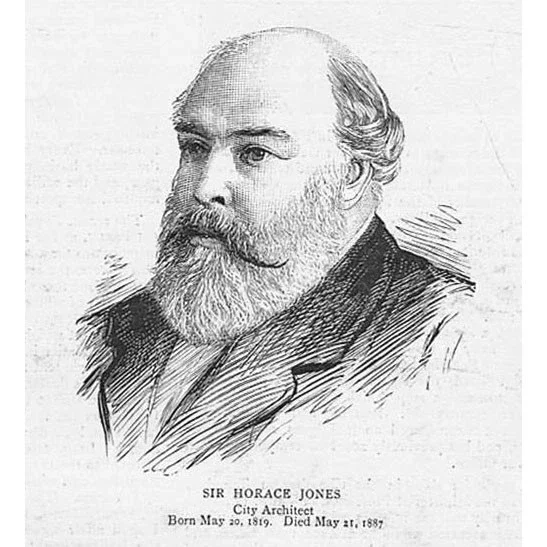
HORACE JONES: BORN 1819
TOWER BRIDGE
In 1864 Jones was elected architect and surveyor to the City of London. He designed and built some of London's most famous markets, in particular Smithfield, Billingsgate and Leadenhall. Jones' final legacy is one of the most recognised buildings in the world, Tower Bridge. It is a strange combination of cutting edge engineering and medieval nostalgia.
BOOKS FROM AMAZON
LIFE
The following was reproduced, with acknowledgement and thanks, from the Tower Bridge website at www.thetowerbridge.info.
The son of a prosperous solicitor, Horace Jones studied architecture and spent some years in Italy and Greece to further his classical knowledge. In 1843 he commenced practice as an architect at 16 Furnival’s Inn, Holborn, and during 18 years designed and carried out many buildings of importance, such as the British and Irish Magnetic Telegraph Company’s office in Threadneedle Street, the Sovereign Assurance office in Piccadilly, Marshall & Snelgrove’s premises in Oxford Street, the Surrey Music Hall, Cardiff town-hall, and Caversham Hall.
He was surveyor for the Duke of Buckingham’s Tufnell Park estate, for the Barnard estate, and the Bethnal Green estate.
On 26 February 1864 he was elected architect and surveyor to the City of London. The City bridges came under his control and he prepared a scheme for widening London Bridge but this did not obtain Government approval.
He completed the City Lunatic Asylum at Dartford in 1864, and in the same year designed a new roof for the city Guildhall. In 1868 he designed and carried out the Central Meat Market, Smithfield, followed in 1875 by the adjoining poultry and provision market, and in 1883 by the fruit and vegetable market. In 1871 he converted the Deptford dockyard into a foreign cattle market, in 1877 he entirely reconstructed Billingsgate Market, and in 1882 rebuilt Leadenhall Market. In 1872 he designed the Guildhall library and museum, and the new council chamber in 1884.
He prepared the memorial surmounted by a griffin to mark the site of Temple Bar (November 1880). From 1882 to 84 he was president of the Royal Institute of British Architects.
Whilst preparing his report of 1876, on the need for another road crossing, he became convinced that the best solution would be a suspension bridge, supported from two piers, with a central opening section 200 feet wide for the larger ships.
In collaboration with (Sir) John Wolfe-Barry he produced the design for Tower Bridge. Within a month of the construction work starting Sir Horace Jones died in 1887, one day after his 68th birthday. His last important work was the Guildhall School of Music on the Thames Embankment.
A JUMPING BUS
The following account of an adventure involving two London icons - Tower Bridge and the London Bus - is reproduced with acknowledgement and thanks from the Tower Bridge website at www.towerbridge.co.uk.
On 30th December 1952, Albert Gunter was happily going about his day job, driving the number 78 bus over Tower Bridge towards Dulwich from Shoreditch. To his utter surprise, the road in front of him seemed to drop away.
Gunter quickly realised that the Bridge was opening, and his bus was on a rising bascule. Slamming his foot down on the accelerator, Gunter managed to jump the rising bascule. He successfully reached the south side of Tower Bridge, which had not yet begun to open, getting all his 20 passengers across safely.
As a precaution, all those of on board were taken to hospital. Thankfully, there was only one person injured: Gunter broke his leg. Amazingly enough, the bus, which was going at just 12 mph (19.3 km/h), was intact.
Peter Dunn, passenger on board recalled
"Before we knew it, we were going across Tower Bridge but just as we had gone over the first half of the section that goes up there was aloud crashing sound and I was thrown onto the floor.
The bus came to a halt and the driver came round to invite us to have a look at the gap that had opened on the opposite half. The driver then told us that as he started to drive across the opening part of the bridge, he realised that the side that the bus was on was going up.
He said he could only think of two options as to what to do: one was to stop the bus and hope some-one would realise what was happening and stop it, but that left the possibility of the bus slipping back and perhaps toppling into the river; the other was to continue driving and to “jump” the gap.
He said that he had been a tank-driver during the war and that a tank would have had no trouble getting onto the other side and decided to see if a double-decker could do the same. So, to his quick thinking, we were all delivered safe to the other side."
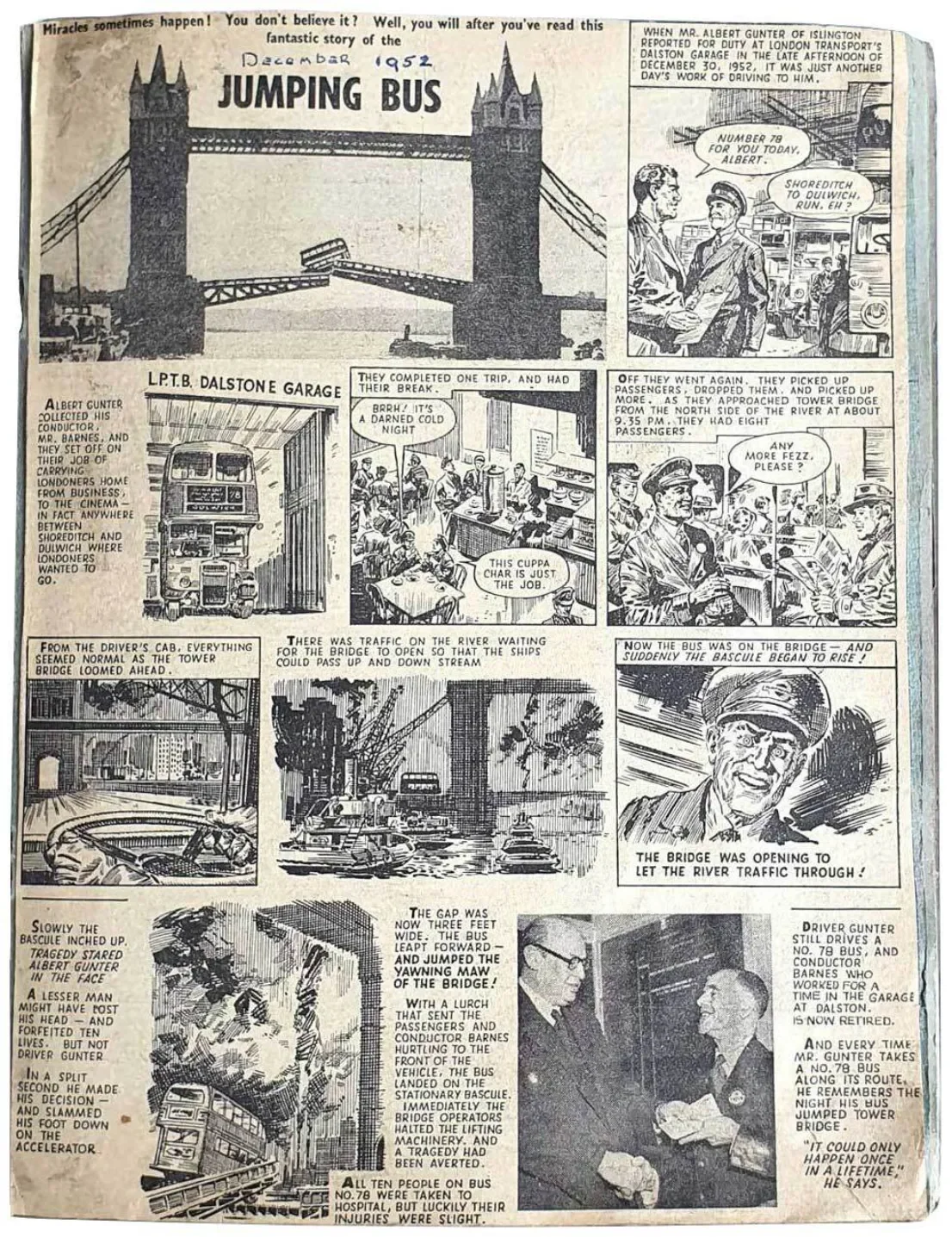
The bus that jumped Tower Bridge, Top Spot Magazine, 20 June 1959 © Rebellion Publishing IP Ltd.