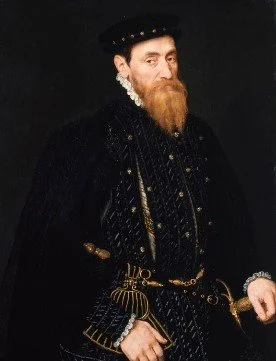
THOMAS GRESHAM: BORN 1518
PIONEERING FINANCIER
Thomas Gresham’s father and uncle were both prosperous city finannciers. It was Thomas who took their work further. He had a brilliant aptitude for finance, and became a valued adviser to monarchs including Elizabeth I. Along the way he accumulated an enormous fortune and became reputedly the richest person in the country.
BOOKS FROM AMAZON
LIFE
The following was extracted, with acknowleedgement and thanks, from the History of London website at www.thehistoryoflondon.co.uk.
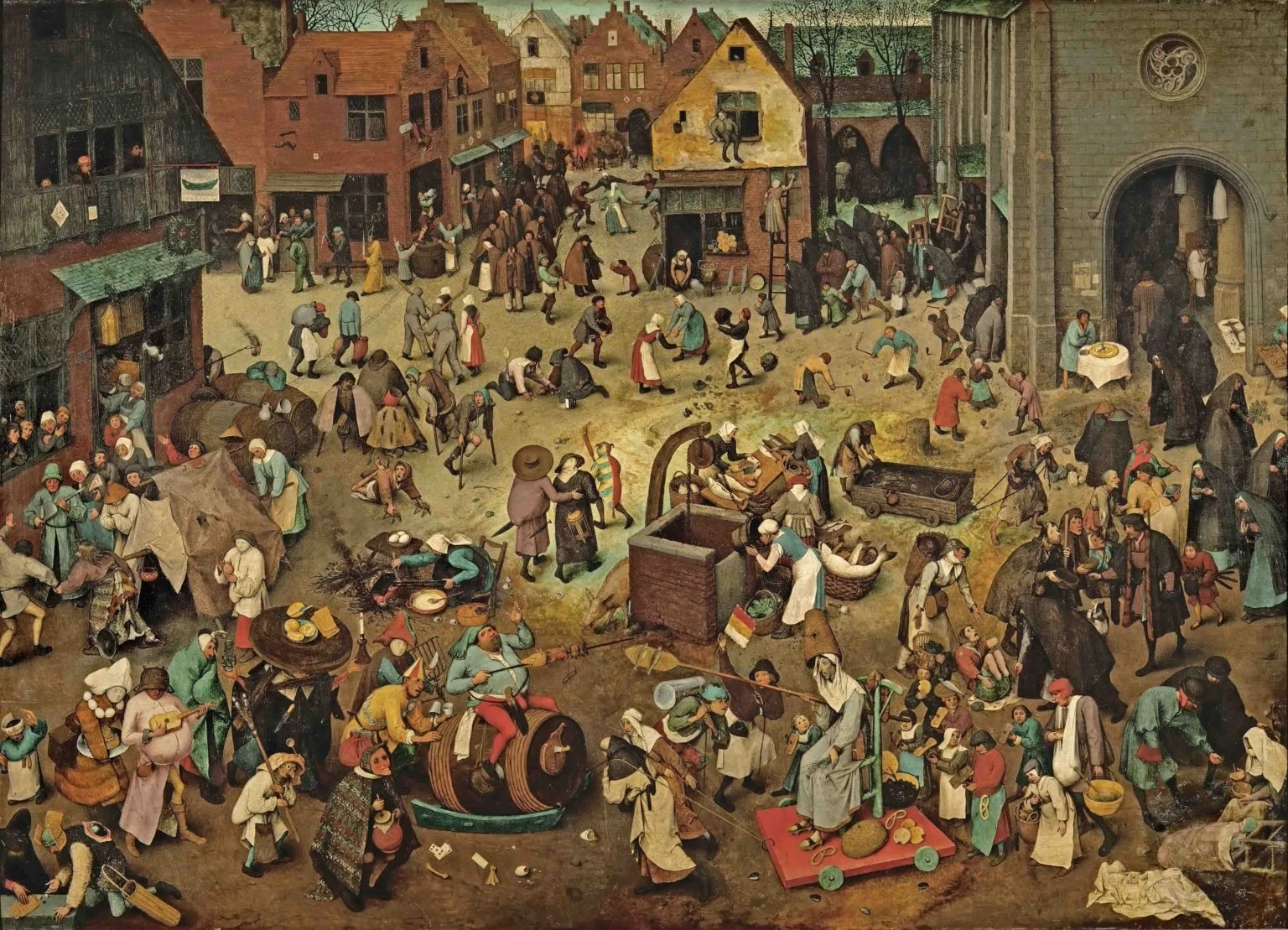
The Fight Between Carnival and Lent' by Pieter Bruegel the Elder, an oil painting from 1559. Antwerp was one of the most important trading cities and cultural centres of Europe in the sixteenth century. It was a thriving and cosmopolitan city where merchants, artists and intellectuals from all over the continent gathered.
Maritime commerce and voyages of discovery required finance, and Antwerp had by the 16th century become Europe’s major money market. It was largely through the efforts of Thomas Gresham that a new financial market was established in London that would eventually supersede its Continental rival, laying the foundation for the City to become the world’s foremost commercial centre. Gresham was also responsible for establishing London’s earliest science college, centuries before the foundation of the capital’s universities.
The growth in trade in London, particularly the funding of voyages of exploration in the 16th century, led to an increasing number of merchants and syndicates raising finance within the City. International shipping and trading was a lucrative but risky business and merchants needed to share that risk. Initially they would do business with each other in the streets. Lombard Street, named after Italian financiers from Lombardy who had settled there, was the main centre for this. Other locations used were in and outside of St. Paul’s Cathedral or within the halls of the Livery Companies. In the 15th century a bourse had been established in Antwerp and the London authorities considered the idea of such a venture in Leadenhall market but nothing came of the plan.
Two of London’s leading men of the mid-16th century were the Gresham brothers, John and Richard. They were hard-working members of the Mercers’ Company who both amassed a fortune and rose to become Mayor of London. John was one of the founders of the Muscovy Company. Richard, who lent money to Henry VIII, was knighted in 1531 and John six years later. Richard proposed a new establishment in Lombard Street where merchants could meet to do business with each other but he died before the plan could be realised.
It would be left to Richard’s second son to accomplish the idea. Thomas was born in Milk Lane in around 1518. At 17 he joined his uncle John’s drapery business, working in both London and the Low Countries. Living between the two, Thomas was able to speak both English and Flemish as well as French and classical languages. He also studied law at Gray’s Inn in London. While still an apprentice, he came to the attention of Henry VIII’s chief minister, Thomas Cromwell, and began undertaking errands on the Continent for the King. Following his apprenticeship Thomas gained the right to membership of the Mercers’ Company in 1543. Three years later he took control of the family business in the Netherlands, exporting woollen cloth from England and importing fine cloth and armaments. When English cloth became less competitive at the Continental markets in the 1540s he diversified into metals.
During the reign of Henry VIII the English Crown was funded in part by borrowing at the Antwerp bourse and during the reign of Edward VI it was managed by the royal agent William Dansall. Interest rates on the bourse were often manipulated by the Habsburg monarchy and when Dansall was forced to pay a higher rate of interest he was displaced by the King’s council with disastrous consequences to the cost of their borrowing. Dansall was therefore replaced by Gresham who then had good fortune when the price of bullion rose dramatically, giving him an opportunity to substantially reduce the Crown’s loans.
Gresham’s moment of glory was cut short when the young Edward VI died and was succeeded by his sister Mary. He and his fellow Merchant Adventurers were suddenly out of favour due to their association with the Duke of Northumberland who had attempted to put Lady Jane Grey on the throne. Gresham returned to his commercial activities.
In 1544 Thomas married Anne Ferneley, the wealthy widow of a mercer, gaining an additional business as well as estates in Suffolk and Norfolk. The couple purchased a house in Cheapside and also had property in Antwerp. As he acquired or inherited further country estates his activities and income adjusted towards his properties and royal duties and away from mercantile commerce.
Royal borrowing did not go smoothly during Gresham’s removal and he was soon reappointed, resuming office in November 1553, although his relationship with Queen Mary’s council was not cordial. He quickly repaired damage done during his absence and when interest rates in Antwerp subsequently soared he instead borrowed at lower cost from Spanish lenders. During the following two years he again borrowed favourably in Antwerp but when rates rose again in 1556 he was removed from his post for a year and a half, during which time the lending of Queen Mary’s government reached much higher levels.
When Gresham was reinstated as royal agent following Mary’s death the Antwerp exchange was no longer under the influence of the Habsburgs and dealt primarily in commercial investment. In a much more stable environment he was able to borrow more favourably for Queen Elizabeth and greatly reduce the Crown’s loans. Now with the full support of the monarch and her chief minister, William Cecil, he became involved in several government services and initiatives. Gresham was knighted in 1559 for his services to the Crown and continued as the royal agent for the first nine years of Elizabeth’s reign.
By then the Gresham family had moved to a new home in the city. What was initially a modest home was extended at great cost into the much larger Gresham House. Tragedy struck in 1564, however, when Thomas and Anne’s son died in a riding accident. Without a male heir, and already in poor health, Thomas decided to use some of his large fortune to create a lasting legacy for the general good, reviving his father’s idea of a public building where businessmen could carry out transactions to rival the bourse of Antwerp. A site was chosen at the junction of Cornhill and Threadneedle Street, and over £3,700 raised by subscription to purchase and demolish 38 houses.
Gresham laid the foundation stone in June 1566 and then oversaw the project during the following three years, together with his friend Richard Clough. The building was designed by an architect from Antwerp in the Renaissance style, with materials and workmen brought from Flanders. For that, the City authorities relaxed their rules on foreign labourers and a special guard had to be kept to protect the workers from enraged London craftsmen. Building work began in summer 1567, using 100,000 bricks donated by the City, together with imported stone for its facing, and completed at the end of the year.
The new Exchange consisted of an arched courtyard around which were statues of English monarchs. A gallery of around 150 small shops and offices was supported on marble columns, very similar to a Roman forum. There was a bell to summon merchants, topped by Gresham’s symbol of a grasshopper, and free concerts performed each Sunday during the summer from a tower.
Initially the idea was slow to take off and it took some years before the building was fully used. In January 1571 the Queen visited to officially open the Exchange, having first dined with Gresham at his home. In order to improve the look of the Exchange for the royal visit Gresham persuaded additional merchants to take space by offering free or reduced rents. The market was given a royal charter and thereafter renamed the Royal Exchange.
Antwerp’s golden period as the cultural and financial centre of Europe ended when a large part of the Protestant population fled following a siege in 1585 by the Catholic Spanish. Many of the bankers emigrated to London and thus enhanced the city as a major European finance centre.
Nearly a hundred years after its foundation, the original Royal Exchange was a victim of the Great Fire. The statues of monarchs were destroyed but that of its founder survived. The Exchange was subsequently rebuilt on two occasions and its successor, built in the 1840s facing the Bank of England and Mansion House, continues today as an upmarket shopping centre.
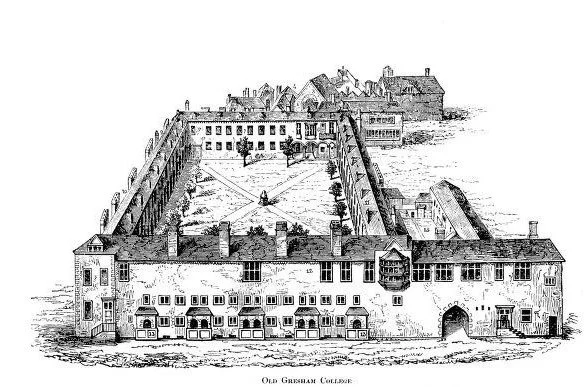
Even before the completion of the new exchange Gresham was considering other lasting legacies. Eight almshouses were constructed behind his mansion at Bishopsgate. Other than the law schools in the Inns of Court, London lacked a university such as those at Oxford and Cambridge. Gresham therefore arranged that after his death, which occurred in November 1579, Anne should continue to enjoy their home but after she passed away it would be converted into an educational college. From that time the rents from the Royal Exchange would pass to the City of London Corporation and the Mercers’ Company to employ and accommodate seven professors at Gresham College to each lecture on a particular science (astronomy, geometry, medicine, law, divinity, rhetoric and music), one per day of the week. Lectures began in 1597.
Gresham College survived the devastation of the Great Fire and for a short period temporarily housed the Royal Exchange, as well as the base for the City of London Corporation while the Guildhall was being rebuilt. For a period of time in the late 17th century Gresham College was also the home of the Royal Society, the group of men, including Sir Christopher Wren and Isaac Newton, with an interest in various forms of science and technical innovation. Lectures continued on the same premises until 1768 and thereafter at various locations in the City until the opening of new premises in Gresham Street in 1842. In 1991 it moved to the ancient Barnard’s Inn at Holborn where free lectures on many subjects continue to be given by learned speakers. The Lord Mayor of London is the president of Gresham College.
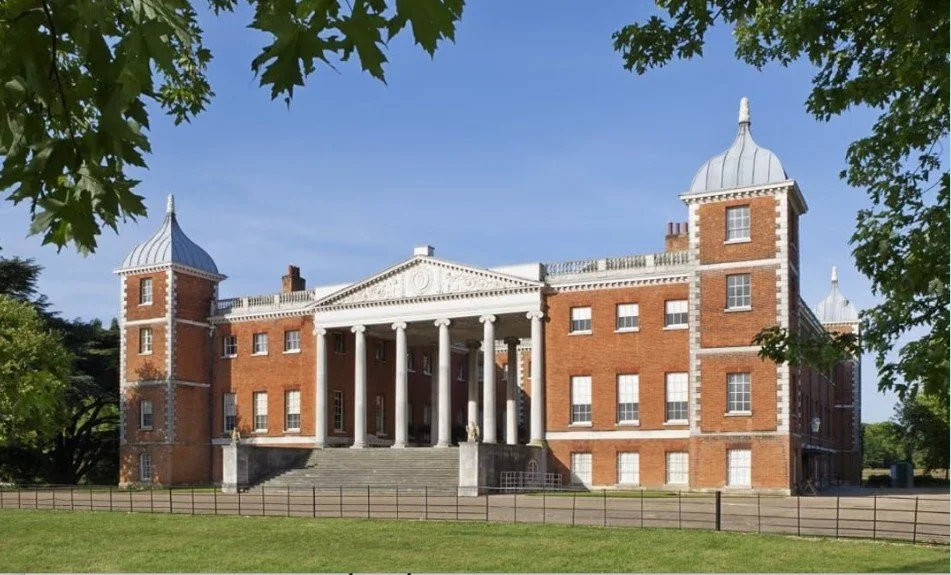
Osterley Park today.
Thomas Gresham also built a mansion at Osterley Park that still survives, although largely rebuilt in the 18th century. Queen Elizabeth once dined with him there during which local residents held a protest by tearing up fences, angered by Gresham having enclosed areas of land. After his death in November 1579 he was buried at St. Helen’s Bishopsgate, with a still-extant tomb that may have been shipped from Antwerp.
The economic principle ‘Gresham’s Law’ was named after Thomas Gresham during the 19th century although it does not have any direct connection with him. The Gresham family symbol of the grasshopper continues to be used by Gresham College and on the weather vane of the Royal Exchange.
Gresham remained vigorously active until he died suddenly, at the age of 59, possibly from apoplexy.
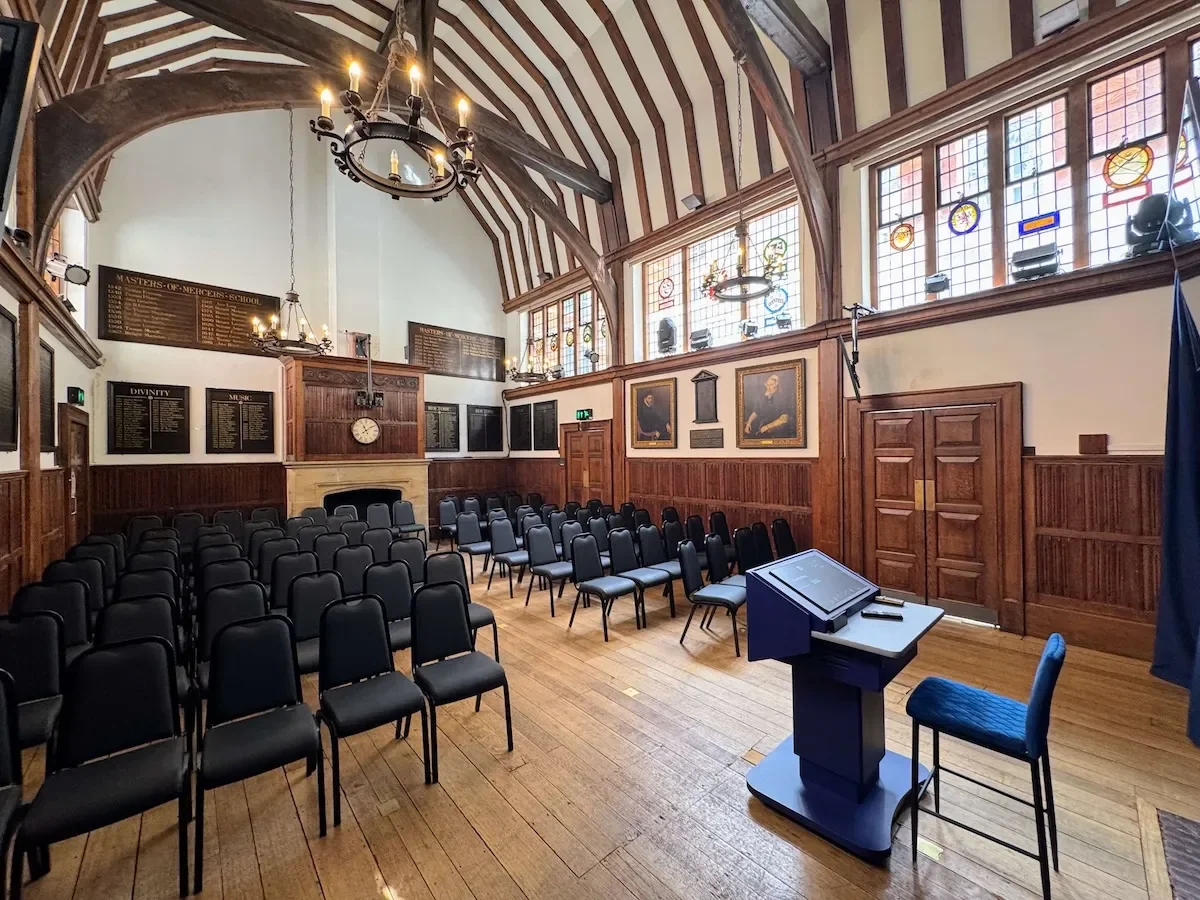
Tucked just off busy Holborn, amongst a dense cluster of much newer buildings is a rare survivor of both the Great Fire and the Blitz: Barnards Inn Hall. This historic gem is now home to Gresham College, an extraordinary institution that has been providing free public lectures for more than 400 years, continuing a tradition that stretches back to the Elizabethan period. The funds for the lectures were provided in Thomas Gresham’s will.