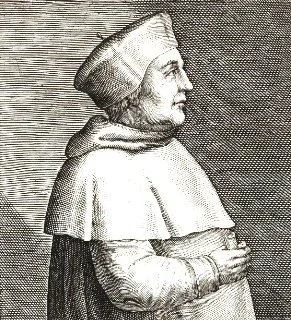
THOMAS WOLSEY: BORN 1473
HAMPTON COURT PALACE
The immense palace that Thomas Wolsey built at Hampton Court was his pride and his downfall. The astonishingly capable son of a butcher from Ipswich, he became an indispensable adviser to both Henry VII and Henry VIII. The apex of his ascent was becoming a Cardinal. But following his failure to secure approval from the Pope for Henry VIII to divorce and marry Anne Boleyn he fell out of favour. Henry VIII saw him as over mighty and ineffective. He forced Wolsey to hand over Hampton Court for the King’s use. Pursued on charges of treachery, Wolsey died in disgrace.
BOOKS FROM AMAZON
LIFE
This account of the life of Thomas Wolsey was reproduced, with acknowledgement and thanks, from the Historic Royal Palaces website at hrp.org.uk.
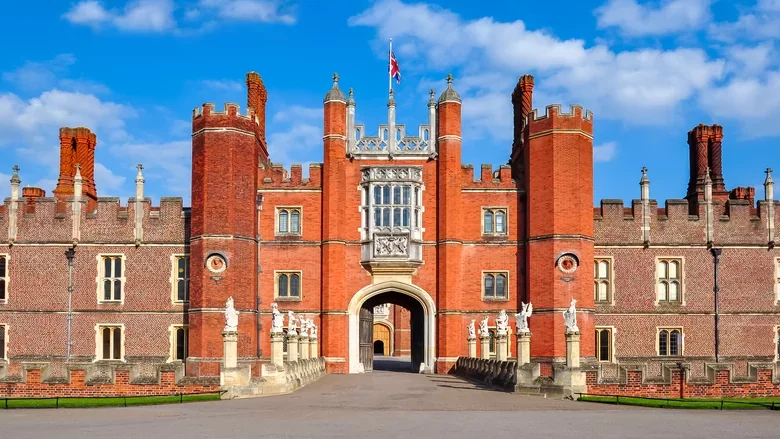
Hampton Court Palace.
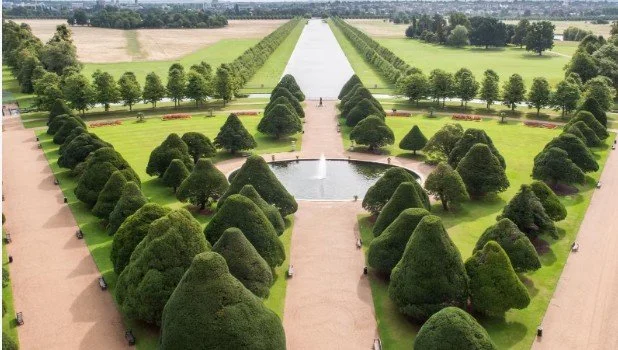
Hampton Court Palace gardens.
Thomas Wolsey and Hampton Court Palace.
The 1500s were a time of great change. In England, Henry VIII's marriage to the Spanish princess Katherine of Aragon in 1509 united the country with a strong European dynasty. The Tudor age offered opportunities for bold and ambitious men to make their mark and achieve power and influence of their own.
One of these men was the son of a butcher from Ipswich, Thomas Wolsey, who had already become a respected priest and administrator at the royal court. It would be Wolsey’s work ethic and talents that would enable the early successes of Henry VIII’s reign.
It would be Wolsey too who would change the fortunes of Hampton Court, transforming a small manor house at the edge of London to one of the most magnificent palaces of the day.
Wolsey became Henry’s chief minister, a Papal cardinal, and a central figure in European politics until his spectacular fall from power in the late 1520s.
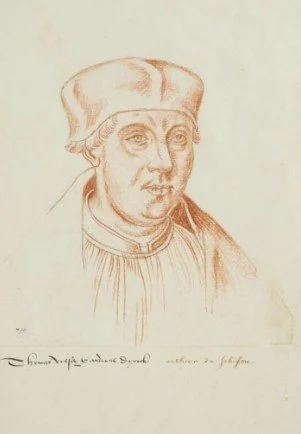
Thomas Wolsey, attributed to Jacques Le Boucq (1520-73) from the ‘Recueil d’Arras’. France, Arras, Médiathèque de l’Abbaye Saint-Vaast / ARCA, IRHT-CNRS
Thomas Wolsey, Son of a Butcher
Thomas Wolsey was born in Ipswich in the early 1470s – we don’t know exactly when. His father Robert ran a tavern in the town and traded as a butcher. Whilst the family had money and property, they were not part of the traditional ruling classes of medieval England.
But the Tudor age opened up new opportunities for those clever and wealthy enough to seize them – King Henry VII was keen to find new, loyal men to challenge the power of the nobility. Wolsey’s modest beginnings would later prompt snobbish ridicule from his rivals.
Education and Early Career
Family money provided Thomas with an Oxford University education to study theology. After graduating, he was ordained as a priest while gaining business experience working for the University, becoming senior bursar at Magdalen College in 1499.
Wolsey’s first church appointment came the following year, in Limington, Somerset, through contacts he’d made at Oxford. But seeking a higher position than parish priest, he also joined the household of Henry Deane, Archbishop of Canterbury, as a chaplain. He also worked for Sir Richard Nanfan, treasurer of the English port of Calais.
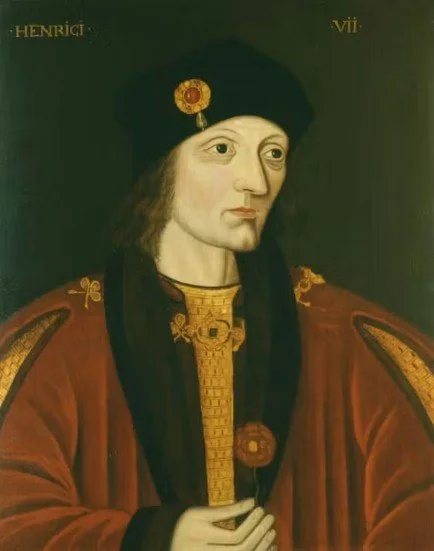
Henry VII, by an unknown artist, late 16th or early 17th century, based on a work of c1490-1500. © Royal Collection Enterprises Limited 2024 | Royal Collection Trust
‘Well beloved clerk and chaplain’ to Henry VII
Always on the lookout for new opportunities, Wolsey’s busy networking got him another post as a royal chaplain, where his diligence and speed of work soon attracted the notice of Henry VII.
The King sent Wolsey on several diplomatic missions in the last years of his reign, to the Netherlands and Scotland. His rewards as Henry’s ‘well-beloved clerk and chaplain’ were more royal and church appointments. When the King died in 1509, Wolsey was one of the men singled out for further promotion, becoming almoner to the new King, Henry VIII.
Wolsey’s Mistress and Children
Flushed with success, but unable to marry because he was a priest (at the time Catholic priests, whatever their role, were meant to remain celibate) Wolsey had two children with ‘Mistress Larke’, Thomas and Dorothy. Later, at the height of his power, this relationship would become an embarrassment, but Wolsey provided for both his mistress (paying for her marriage in 1519) and his children.
There was in the royal household a priest named Thomas Wolsey, one of the number of royal chaplains, not unlearned in Scripture, a clever fellow, and most ready for any undertaking.
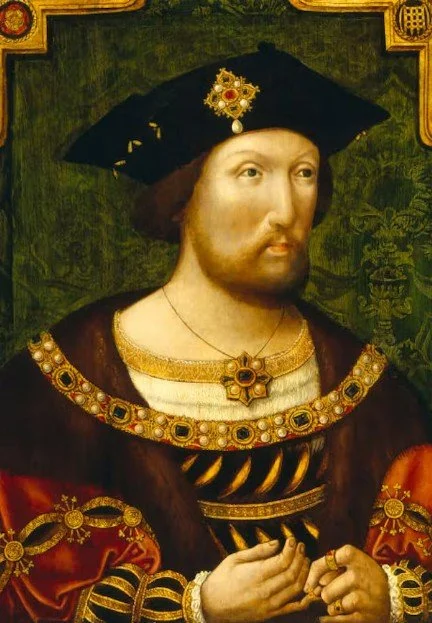
Portrait of Henry VIII, by an unknown artist, c1520. © National Portrait Gallery, London
Thomas Wolsey and Henry VIII
Over the next few years, Wolsey made himself as indispensable as possible to Henry VIII, seeking out friendships and alliances with Henry’s councillors, and earning a reputation for efficiency and managing the tedious workloads of everyday government.
He also listened. And paid attention to the youthful aspirations of his royal master. Henry VIII was only 18 in 1509, and wanted to emulate his royal heroes of the past by winning a glorious victory against England’s traditional enemy, France, on the battlefields of western Europe.
War with France
Wolsey became the director of Henry’s military campaign of 1513, backing the King against the advice of some of his ministers. He arranged for the supply of the army, the mustering of ships and organised the raising of the enormous funds required. The English army captured Tournai and Thérouanne, and forced the French to accept a peace treaty that married Henry’s sister Mary to Louis XII King of France.
Success for the Tudors meant rewards for Wolsey. In 1514, he became Archbishop of York, and the following year Lord Chancellor, effectively Henry’s chief minister. At the same time, at the King’s request, the Pope created Wolsey a ‘Cardinal’.
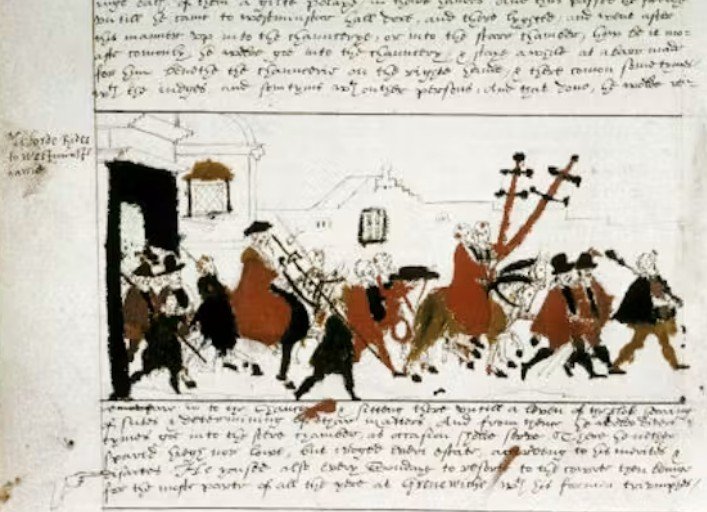
Wolsey at the height of his power, surrounded by his entourage, from a 1578 version of the biography written by his servant George Cavendish, compiled in the 1550s. The Bodleian Libraries, University of Oxford, Bodleian Library MS. Douce 363, fol. 052v
Chief Minister and 'Alter Rex' ('The Other King')
All of this made Wolsey in charge of Henry’s home and foreign policy, of England’s legal system, and of England’s relations with the Catholic Church.
For the next 15 or more years, Henry would do little without the help, support and guidance of a man who became known to some as the alter rex (the other king). As the political landscape shifted, and England’s policy moved from war to peace, it was Wolsey, again, who played the key diplomatic role.
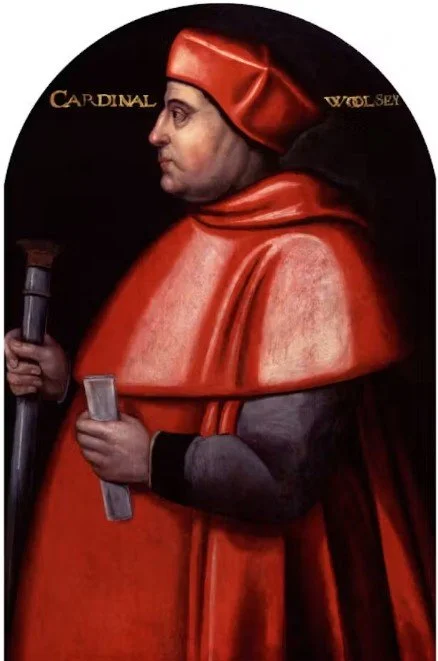
Thomas Wolsey in his Cardinal's robes, by an unknown artist, c1589-95, based on a work of c1520. © National Portrait Gallery, London
The Field of Cloth of Gold
Wolsey positioned England and the King as an arbiter between the two, more powerful European ruling dynasties of France and the Holy Roman Empire. He negotiated a complex series of peace treaties, supported by the Pope, who wanted the whole of Europe to stand together against the threat of the expanding Islamic empire of the Ottomans.
In 1520, the Treaty of London between England and France was celebrated in lavish style at a festival and sporting tournament held near Calais. So magnificent was the occasion, as both the English and French courts tried to outdo each other, that it became known as The Field of Cloth of Gold.
Henry and Wolsey were, throughout the 1510s and early 1520s, a formidable team.
The Cardinal does everything … All negotiations pass through the Cardinal, who manages everything with consummate ability, integrity and prudence. The King pays the Cardinal such respect that he speaks only through [Wolsey’s] mouth.
Francesco Chieregato, Papal Nuncio, on Thomas Wolsey, 1517
Thomas Wolsey’s Hampton Court
In 1514, a small army of builders and labourers, craftspeople and decorators began converting a relatively modest manor house at Hampton Court into a fashionable palace. Wolsey’s new home would be fit to entertain not only Henry VIII and his court, but also rulers and visitors from all over Europe.
Built to impress, Thomas Wolsey’s Hampton Court Palace reflected the styles and fashions of Renaissance Europe, and by the 1520s was one of the most splendid and modern buildings in the country. There was enough room for grand entertainments, guest bedroom suites for the royal family (over three floors – one each for Henry VIII, Katherine of Aragon and their daughter Princess Mary) and even a Chapel.
Surviving Fragments of Magnificence
Not much of Wolsey’s original residence survives. Henry VIII took over Hampton Court and rebuilt it, expanding it further into a great royal palace. And much of Henry’s palace was also demolished by the rebuilding and modernisation programmes of later monarchs.
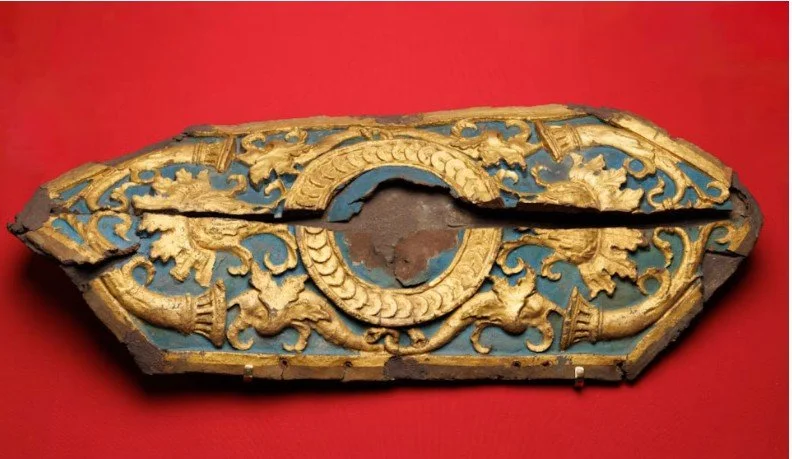
Surviving gilded and painted fragments of Wolsey's palace show typical Renaissance designs. This ‘shield’ features dolphins and floral motifs. © Historic Royal Palaces
The Wolsey Rooms
In a rather secret corner of Clock Court, hidden behind the late 17th-century entrance to William III’s State Apartments, visitors can still find a set of rooms that once formed part of Wolsey’s private apartment.
The Wolsey Rooms would once have extended over three floors, but the six rooms that remain, with their gilded ceilings and linenfold panelling, still give an indication of Tudor luxury and Wolsey’s success. You can imagine Wolsey still here, looking out of the gardens towards the river Thames, awaiting the arrival of the French ambassador perhaps, or an envoy from the Pope.
Wolsey’s Hampton Court, as well as his other 'official' residence, York Place in Whitehall (that later became Whitehall Palace) were where the big conversations of the 1520s took place. This is where the Tudors met the rest of the world.
Wolsey spared little expense in furnishing his rooms. A diplomat from Venice described how you had to cross eight rooms before reaching his audience chamber, and all the rooms were hung with fine tapestries, which were changed once a week. Wolsey collected or commissioned over 600 tapestries during his lifetime, while he lined his own private chamber with cloth-of-gold.
Base Court
What's left of Wolsey’s Hampton Court also includes 'Base Court', the vast accommodation block built for his important guests, as well as parts of his original kitchens.
The Wolsey Closet
The ceiling of the Wolsey Closet is one of the finest examples of Tudor interior design at Hampton Court. The room was created by Wolsey for Henry VIII as part of the royal apartments at the palace in the 1520s.
Yet such visible flamboyance and advertised success attracted criticism and jealousy. Wolsey’s palace at Hampton Court was described as more impressive than the King’s. Wolsey’s argument was that the palace belonged to Henry VIII – he was just the King’s loyal servant in a grand residence designed to reflect Tudor power and magnificence. In a few short years, Wolsey was to be proved correct.
In came a new banquet before the King's Majesty, and to all the rest through the tables, wherein I suppose was served two hundred dishes or above of wonderous costly meats and devices subtly devised. Thus passed they forth the whole night with banquetting, dancing and other triumphant devices to the great comfort of the king and pleasant regard of the nobility there assembled.
George Cavendish, in 'Life and Death of Cardinal Wolsey' first published in 1558
European Isolation
Universal peace in Europe, so carefully negotiated by Wolsey, did not last. In 1525, the armies of the Holy Roman Emperor, Charles V defeated the forces of Francis I, King of France at the Battle of Pavia, as both rulers fought over control of northern Italy. Francis was captured, and ultimately signed a separate peace treaty with Charles.
This left England isolated, and with few cards to play. Henry VIII had been married to Katherine of Aragon for 20 years, but a story of still-births and infant death had left them with only one daughter, Princess Mary. Henry needed a son and heir, both to secure the Tudors as the ruling dynasty in England, and to negotiate marriage alliances abroad.
Anne Boleyn and Henry VIII’s ‘Great Matter’
The arrival of Anne Boleyn at the English court offered Henry new hope. He planned to divorce Katherine, marry Anne, and acquire the family he craved. But this was not straightforward, even for the King of England.
With Katherine refusing to accept her fate, Wolsey was charged with finding a solution. This meant appealing to Pope Clement VII, who could provide Henry with an annulment, and legitimise his second marriage.
But the Pope’s political authority was limited, as he was himself reliant on the support of Emperor Charles V. It suited Charles to have Henry remain without a male heir, and effectively powerless, so he wasn’t inclined to help.
Wolsey's Defeat and Death
Wolsey failed to resolve Henry’s 'Great Matter' and lost his power and some of his positions as a result. In 1529, he surrendered Hampton Court to the King, and travelled north to visit his Yorkshire archdiocese. But in his desperate attempts to retain his favour with Henry, he overstepped his authority by negotiating with continental contacts without the King's knowledge.
Accused of treason, the Cardinal was summoned back to London. By this point, he was not a well man. Apparently overweight and troubled by a variety of illnesses and infections, grief and fear, Thomas Wolsey fell sick at Leicester Abbey, and died in the early hours of 29 November 1530.
And there being all alone… by the chimney, in my lord’s bedchamber, the earl trembling said, with a very faint and soft voice… “My, lord I arrest you of high treason”… my lord was marvellously astonished, standing both a long space without any further words…
George Cavendish, in 'Life and Death of Cardinal Wolsey', first published in 1558
Pride and Fall: How Should We Remember Thomas Wolsey?
The story of Thomas Wolsey’s rise and fall is often told as a cautionary tale. Beware the perils of being too ambitious and becoming so powerful, that you sow the seeds of your own destruction. In this version of events, Wolsey angered both the King with his extravagance, and incurred the envy of his rivals at court. He was a Tudor ‘villain’ described by his successors and enemies as a fat, lecherous, vainglorious tyrant, who deserved his fate.
Wolsey certainly inspired jealousy and criticism, but what finally brought Wolsey down was Henry VIII’s ‘Great Matter’, the King’s desire for an annulment from Katherine of Aragon so that he could marry Anne Boleyn. Wolsey couldn’t deliver. And when a man like Wolsey falls from power, his enemies are all too quick to seize an opportunity.
Tudor Icon and Hampton Court Celebrity
Yet we should remember Wolsey as one of the Tudor age’s great administrators, who did his level best to enable Henry VIII’s aspirations to be a great ‘Renaissance Prince’. He aimed to position England at the centre of European politics and culture, through his busy, clever diplomacy and his patronage of art and architecture.
Wolsey initiated reforms in taxation and government management that allowed Henry’s court to flourish, increasing royal revenue and centralising authority. He also made it easier for his successors, like his protégé Thomas Cromwell to govern well.
At Hampton Court, his legacy is the palace itself, which would not have become Henry VIII’s great pleasure palace without Wolsey’s investment and energy.