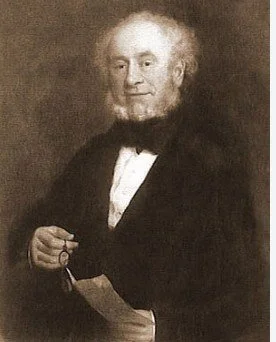
JOHN MOWLEM: BORN 1788
MASTER BUILDER
John Mowlem was one of six children of a shopkeeper in Swanage, Dorset. With his younger partner George Burt he built a substantial contracting company, initially specialising in stone paving in London. He went on to build numerous stone buildings in London, and the firm continues today. He and Burt retained strong connections with Swanage, where they made many philanthropic contributions. These included the Great Globe, and the Town Hall, whose facade was the re-purposed front of the 17th century Mercers Hall in London, transported stone by stone to Swanage.
BOOKS FROM AMAZON
LIFE
The following account of John Mowlem’s life is reproduced, with acknowledgement and thanks, from the Dorset Ancestors website at www.dorset-ancestors.com.
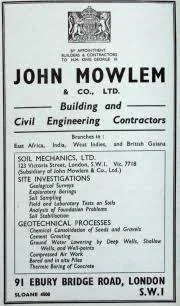
Many people will have noticed the name Mowlem on the side of heavy construction machinery without giving a thought to the story behind the name. But this business of international renown had, as had so many others, very lowly beginnings: with a man born in an ancient cottage at Carrants Court, Swanage on October 12th, 1788. John Mowlem was one of six children; four of who were boys, born to a general store keeper whose name was also John.
By the early 1800’s when he would have been in his early teens, young John joined his three other brothers at work in the Tilly Whim Purbeck stone quarry. These were the days when child labour for farms and industries was universal because it was cheap. But by 1812 the effect of the recession caused by the long naval war with France had hit the Purbeck quarries, and Tilly Whim closed.
During these years it is believed that Mowlem came under the tutelage of Dr. Andrew Bell, Rector of Swanage from 1801 to 1809 and a learned schoolmaster, though the younger John’s education came mainly through the experience of his working life. Another milestone for Mowlem came in 1804, when Henry Manwell, a son of a friend of John Mowlem senior, left Swanage to go to work as a stone cutter in Portsmouth, but not before suggesting that his son John could find employment in the same industry in the Isle of Wight.
Accordingly and soon after, Mowlem threw up his job in the Purbeck Quarry with the original intention of finding a job in London. About this move there is a romantic story of how, with little more than his sack of tools, John persuaded a local captain to grant him a free berth on his vessel. But Mowlem’s nephew George Burt later noted that John did not go directly to London but stopped off at the Isle of Wight. Here, at the Norris Castle Quarry, he found his first job outside of Dorset.
After he had been at work in the Norris Castle Quarry for some while Mowlem was spotted by James Wyatt, an architect who recommended him to Henry Westmancott, one of two brothers in charge of running a masonry and sculpture workshop for the Government Masons Department in London. Following up this recommendation Mowlem left the Isle of Wight and moved into lodgings adjacent to the Westmancott’s in Mount Street, near to the site of the shared workshop in Pimlico.
It was during these earliest years in London, sometime in the first decade of the 19th century, that Henry Manwell’s sister Susannah visited her brother, by then living in London and working as the rate collector for St. Marylebone. Inevitably this brought her into contact with John Mowlem, to whom she soon found herself attracted, and in 1812 he and Susannah were married. That year Robert Burt, long a friend of John’s married Susannah’s sister Letty in Swanage Church.
At this time the Government masons works had contracts for work at Greenwich and Kensington Palaces, the Royal Mews and Somerset House. For all these contracts in the capital Mowlem was made foreman over all the workers in 1816. He was later to record that he was put over men “..old enough to be my father.” But despite the promotion, Mowlem did not hold his boss in any high esteem. Indeed, he said of Westmancott that he was a hard niggardly taskmaster who paid him only punitive wages. He further wrote that the only virtues he (Westmancott) possessed, which he made a point of emulating were punctuality and cleanliness.
Mowlem left the Westmancott’s works in 1822 to found his own company with only about £100 capital, though he was much helped by several friends including MacAdam, who pioneered pitched road surfacing. Initially the company had much to do with the paving of roads, but as soon as he was solvent Mowlem took out a lease on a wharf in Pimlico basin, on the site later occupied by Victoria Station. It was to these works that the contractor imported Purbeck Limestone, York Sandstone, and Aberdeen Granite for many of the London landmarks we know today. With the help of his brother-in-law Henry, Mowlem next moved his office and yard to Paddington Wharf, then known as Little Venice.
Two of John’s brothers James and Joseph also went into business of their own in London, leaving Robert the only one of the brothers never to leave Swanage. Then in 1853 George Burt, who had mastered the craft of masonry in the Swanage Quarry, went into partnership with Mowlem in the capital. A third, a Yorkshireman called Joseph Freeman then joined the two men to form a company, which then operated under the name Mowlem, Burt and Freeman. Freeman married Elizabeth Burt, George’s sister in 1839.
Shortly before 1840 the company began work on its first major contract: re-paving Blackfriars Bridge with a Telford pavement of Granite setts. This was the first such pavement of its kind, and the contract specified that a delay in completion would incur a heavy penalty with no stage payments. But a shortfall in the supply of the granite led Mowlem to purchase another quarry on Guernsey. It was therefore Burt and Freeman who were left to manage the business during the time that Mowlem was overseeing the shipping of the rock from the Channel Island. Following the success of the undertaking Mowlem went on to re-pave London Bridge and the Strand.
But Mowlem was considering retirement before 1838, when he would have been 50. He is often regarded, together with Burt and William Morton Pitt, as one of the three gentlemen of Swanage. Morton Pitt was a wealthy entrepreneur and Dorset MP who had built Belvedere, a seven-room house in Swanage for which Mowlem made a failed purchase bid of £260. A Chancery sale took place at the Royal Victoria Hotel in 1838 and included the hotel itself, the Quay, Seymer Place, Sentry Field, the Watch and Preventative Station, Durlston Quarries and Whitecliff Farm. Mowlem moved into 2, Victoria Terrace, a road named after the future Queen who, when a Princess, made a brief stay at the hotel Pitt had developed and which was itself re-named after her.
Between 1858 and 1860 Mowlem bought the estate now occupied by most of Swanage north of the brook and extending to Ulwell. During these years he played a part in the construction of the town’s first pier (now gone) and the granite memorial on the seafront to King Alfred. In 1862 he added a memorial to Prince Albert and founded the Mowlem Institute, now the Mowlem Theatre.
Mowlem passed his retirement by watching the coast from an observatory on the roof of the house and by starting a famous diary, which he kept for the rest of his life. Burt meanwhile took full charge of Mowlem’s company in 1844 and undertook an ambitious landscaping project in what is today Durlston Park. This included the estate’s castle and The Great Globe, a massive 40-ton stone ball made in the Mowlem works and shipped to Durlston in 15 segments. Here the monument was set up on a platform just below the castle.
John Mowlen died in 1868, ten years before his company would become involved in electrifying the tramways, including the work of building the Northumberland Avenue Tramway, so beginning the long association of the name Mowlem with today’s transport infrastructure. In recent times Mowlem’s company also built the Dorchester by-pass, the new London Bridge, the Vickers Tower on Milbank, London Airport, and roads and docks, sewers and tunnels.
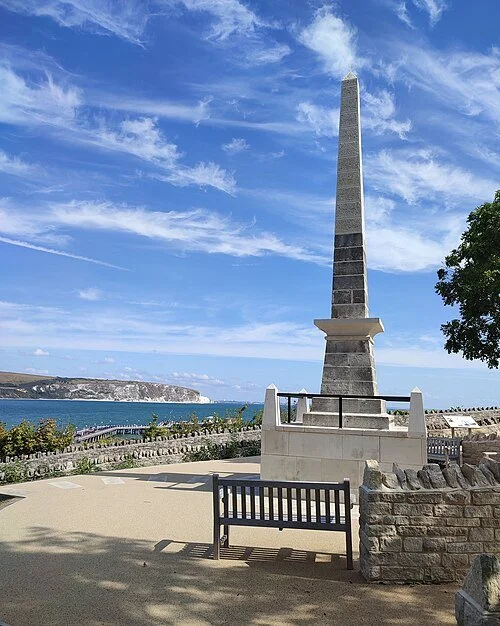
In January 1862, just four weeks after Prince Albert's death, Swanage builder George Burt wrote to the Rector of Swanage, the Revd Duncan Travers, to propose the erection of an obelisk of native stone.[1] Burt's design was modelled on the obelisk in Ludgate Circus (now in Salisbury Square, off Fleet Street), commemorating the politician Robert Waithman.
Built of Purbeck stone, the memorial was the first civic memorial to be erected to Prince Albert, in 1862. The memorial by Thomas Worthington in Albert Square, Manchester, was the first major memorial and the first to depict an effigy of the Prince, but was not erected until three years after the one in Swanage, in 1865. The memorial was located on Court Hill, near to the current site of the Royal British Legion.
The Great Globe, Swanage
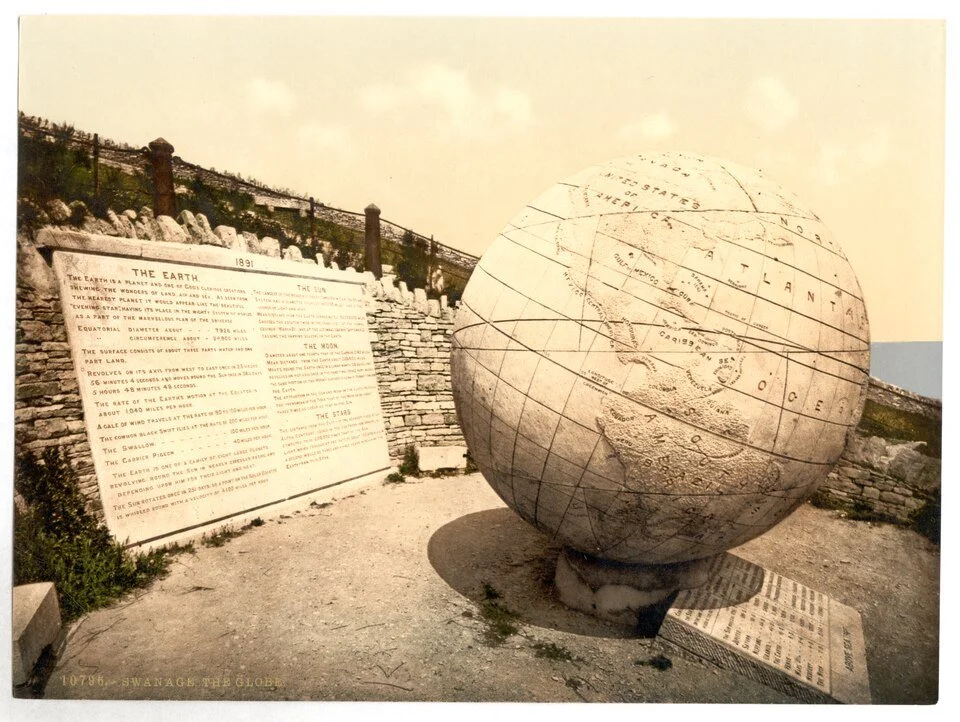
The Great Globe, Durlston Country Park (1890s photochrome)
The Great Globe at Swanage is one of the largest stone spheres in the world and stands at Durlston Castle within Durlston Country Park, a 113-hectare (280-acre) country park and nature reserve. It is constructed of Portland stone, weighs about 40 tonnes and is 3 metres (10 ft) in diameter.
Constructed in Greenwich in 1887 in Mowlem's stone-yard (whose founder John Mowlem had lived in Swanage), it was brought to Swanage by sea. The Globe, which is made of Portland stone, consists of 15 segments, with four stones for each of the lower three courses and three in the top-most course, the segments connected by granite dowels. It measures 10 feet (3.0 m) in diameter and weighs 40 tons. Its surface is carved in detail and lettered to show the continents, oceans and certain more specific areas of the world. It was erected by W.M. Hardy that year upon a platform cut into the solid rock of the hill some 136 feet (41 m) above sea level. Around the globe is a set of stone plaques carved with quotations from English, Roman poets and the Bible, and also various facts about the natural world. These were not completed until 1891. Eight large stone blocks around the globe represent the points of the compass. The globe is now surrounded by an iron fence.
The globe is a Grade II listed building, having been designated thus in 1983.
Swanage Town Hall
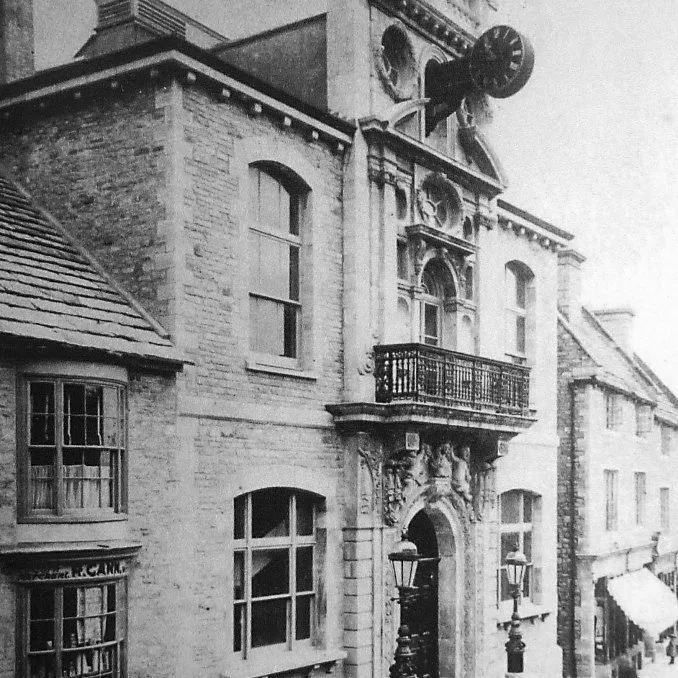
Swanage Town Hall was built by George Burt in 1882. To adorn it he acquired the entire 17th Century stone facade from the Mercers’ Hall at Cheapside in London.